
Supernova's Ancient Light
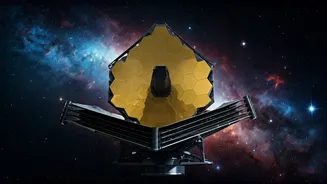
The James Webb Space Telescope (JWST) has made a groundbreaking discovery, confirming the existence of the oldest supernova ever witnessed. This supernova,
linked to the gamma-ray burst GRB 250314A, is a remarkable find. Analyzing this ancient light allows scientists to understand the early universe, including the composition of stars and the processes of their explosions. These findings provide a glimpse into the cosmic origins. The discovery reinforces the power of advanced telescopes. Such telescopes push the boundaries of what scientists can observe and understand about the universe's past. This contributes significantly to our understanding of the cosmos's evolution.
Black Holes and Mergers
Observations from the Euclid telescope reveal fascinating insights into the relationship between galaxy mergers and supermassive black holes. The data suggests that when galaxies collide, these colossal black holes, residing at the centers, become highly active. This newfound connection is crucial for understanding how galaxies evolve and grow. The Euclid mission enables detailed studies of the universe's structure and the behavior of galaxies across vast cosmic distances. The study of galaxy mergers also assists in mapping dark matter and exploring the universe's large-scale distribution. This helps to paint a comprehensive picture of how the cosmos has changed over billions of years.
Einstein's Theory Verified
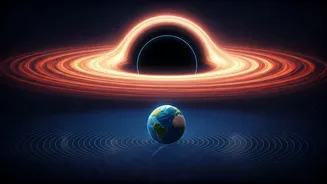
Astronomers have observed a star's wobble around a black hole, confirming Einstein's century-old theory of frame-dragging. This observation validates a key aspect of general relativity, showing how a massive object can warp the space-time around it. Frame-dragging is where a rotating object drags the space and time around it. The observations have provided further proof of Einstein's prediction. They highlight how the predictions of the theory continue to hold true. The ongoing exploration of black holes and the verification of these theories highlight the importance of pursuing advanced physics. They continue to shape our understanding of the universe's fundamental laws.
X-Ray Views Unveiled
Chandra's X-ray mapping has produced unique, color-coded views of galaxy clusters, revealing hidden cosmic activity. These X-ray images disclose the unseen engines driving galaxy cluster dynamics. They help reveal the interactions of gases and the presence of supermassive black holes. The use of X-ray imaging provides critical data for the study of galaxy evolution. These images allow astronomers to examine the hotter regions of the universe. This type of high-resolution imaging offers a deeper understanding of the processes occurring within and around these galaxy clusters. This allows researchers to study how these galaxies evolve over time.