






April's Enchanting Pink Moon
As spring unfolds in the Northern Hemisphere, April brings with it a special full moon, known as the Pink Moon. This celestial event, which reached its
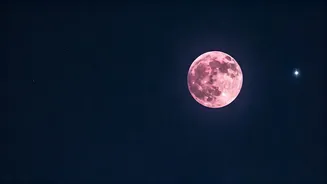
peak illumination on April 1st, offers a brilliant display that continues to be visible in its bright, full phase on March 31st and April 2nd. A particular treat on April 1st is the moon's proximity to Spica, the radiant star in the Virgo constellation, creating a striking visual pairing. It's important to note that the Pink Moon's name isn't indicative of its hue, which remains the familiar silvery-white. Instead, this moniker is derived from the blooming of the pink phlox wildflowers, native to North America, which typically flourish during April. Indigenous communities across North America have bestowed other evocative names upon this moon, reflecting the season's changes. For example, the Algonquin people refer to it as the Breaking Ice Moon, while the Dakota know it as the Moon When the Streams Are Again Navigable. The Tlingit celebrate it as the Budding Moon of Plants and Shrubs, and the Oglala observe it as the Moon of the Red Grass Appearing. Many Anishinaabeg (Ojibwe) people in the Great Lakes region identify it as the Broken Snowshoe Moon, symbolizing the thawing and easier travel conditions that arrive with spring.
Cultural & Religious Significance
The April Pink Moon holds significant meaning in various cultural and religious traditions. For those observing the Jewish calendar, the rise of this full moon marks the commencement of Pesach, also known as Passover. This year, Passover began at sunset on April 1st, corresponding to the 15th day of the Hebrew month of Nisan. This timing is intrinsically linked to the lunisolar nature of the Hebrew calendar. In Western Christianity, the first full moon of spring plays a crucial role in determining the date of Easter Sunday. The tradition dictates that Easter falls on the first Sunday after the first ecclesiastical full moon occurring on or after the vernal equinox. Given that the vernal equinox occurred on March 20th, and the Pink Moon followed on April 1st, Easter Sunday was celebrated on April 5th. For adherents of Eastern Orthodox Christianity, Easter was observed a week later, on April 12th.
Optimal Viewing Tips
To fully appreciate the splendor of April's Pink Moon, the optimal night for observation was Wednesday, April 1st. As the sun set across North America, the full moon ascended in the eastern sky, offering a breathtaking spectacle. For the best viewing experience, it is recommended to find a location with an unobstructed view of the eastern horizon and to consult local astronomical listings for precise moonrise times. On this particular evening, observers were treated to the sight of Spica, a brilliant star belonging to the Virgo constellation, appearing close to the Pink Moon. The celestial display continued into the following night, Thursday, April 2nd, when the moon, transitioning to a waning gibbous phase, remained a mere 1.8 degrees away from Spica, still presenting a visually appealing celestial conjunction.
May's Anticipated Blue Moon
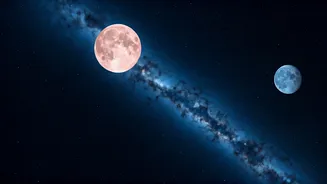
Following the Pink Moon in April, the astronomical excitement continues into May with another full moon, known as the Flower Moon. This May full moon is also referred to as the Corn Planting Moon and the Milk Moon, reflecting traditional agricultural and seasonal connections. What makes May particularly special this year is that it will host not one, but two full moons. The second of these, occurring on May 31st, is a rare phenomenon termed a 'Blue Moon.' This designation applies to the second full moon that appears within a single calendar month. This occurrence is relatively infrequent, making the May 31st Blue Moon a highly anticipated event for skywatchers.