






Eco-Cities Redefined
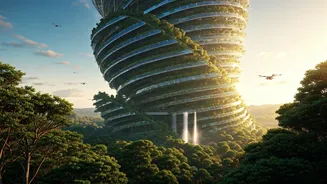
Imagine urban landscapes that breathe, where buildings are not just structures but living ecosystems. Future cities are envisioned as self-sufficient entities,
minimizing their ecological footprint through integrated renewable energy systems, advanced waste management, and vertical farming. These aren't just skyscrapers; they're vertical villages designed to house populations efficiently while purifying air and water. Think of sprawling, multi-tiered metropolises where transportation is seamlessly integrated, reducing reliance on personal vehicles and promoting public and electric transit. Water harvesting and recycling systems would be paramount, ensuring a closed-loop supply. Green spaces would be woven into the fabric of these cities, not as afterthoughts, but as essential components for well-being and biodiversity. The concept aims to create densely populated areas that are paradoxically more in harmony with nature than many of today's sprawling suburbs, offering a blueprint for urban living that prioritizes both human needs and planetary health. This approach moves beyond mere sustainability to regeneration, actively improving the environment within and around the urban core.
Oceanic Habitats Evolve
As land becomes scarcer, humanity's gaze is turning towards the vast expanse of the oceans, envisioning floating cities and underwater habitats. These aquatic megastructures are designed to harness the immense power of the sea, from tidal and wave energy to aquaculture for food production. They offer solutions for rising sea levels and population growth, providing new frontiers for human habitation and research. The engineering challenges are immense, requiring robust materials resistant to corrosion and extreme weather, as well as sophisticated life support systems. However, the potential benefits include reduced pressure on terrestrial ecosystems and the creation of novel living environments. These structures could serve as research outposts, sustainable agricultural centers, or even self-contained communities, pioneering new ways of living in balance with marine environments. The development of such habitats necessitates a deep understanding of ocean dynamics and a commitment to minimizing any disruption to marine life, fostering a symbiotic relationship rather than an exploitative one. The vision is one of coexisting with the ocean, rather than conquering it.
Atmospheric Solutions Emerge
Beyond terrestrial and oceanic realms, ambitious ideas are emerging to address atmospheric challenges through megastructures. Concepts include massive solar power stations orbiting Earth to beam clean energy down, or colossal atmospheric scrubbers designed to remove greenhouse gases directly from the air. These are not mere speculative ideas but potential game-changers in the fight against climate change. Imagine orbital platforms that capture solar energy far more efficiently than ground-based installations, providing a virtually inexhaustible supply of clean power. Alternatively, consider giant atmospheric processing facilities that, while potentially controversial due to their scale, offer a direct intervention in mitigating the effects of industrial pollution. These proposals push the boundaries of engineering and resource allocation, requiring international cooperation and unprecedented technological advancements. The goal is to create systems that can actively heal the planet's atmosphere, offering a hopeful vision for environmental restoration on a global scale, moving beyond simply reducing emissions to actively reversing damage.