






Uranus: An Unexplored Frontier
Uranus, one of our solar system's enigmatic ice giants, remains largely a mystery. Despite being identified as a top priority for exploration by the National
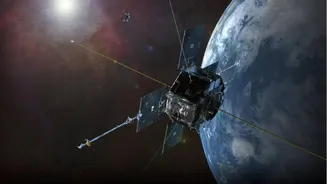
Academies' 2022 Decadal Survey, a concrete mission plan for the 2030s launch opportunities is still in development. This delay, however, might be an advantage, as cutting-edge launch technologies like SpaceX's Starship are emerging as potential game-changers. Researchers at MIT have investigated how Starship’s unique capabilities could revolutionize the design and execution of a proposed Uranus Orbiter and Probe (UOP) mission. The planet’s peculiar axial tilt, its offset magnetic field, and its fascinating moons, which may harbor subsurface oceans, all present compelling scientific questions that have gone unanswered due to a lack of sustained observation. The only prior visit was a brief flyby by Voyager 2 four decades ago, leaving Uranus and Neptune as the sole planets never studied up close for an extended period. Understanding Uranus is also crucial for comprehending the vast number of exoplanets discovered that share similar characteristics, offering insights into planetary formation across the galaxy.
The Tyranny of Distance
The immense distance to Uranus poses a significant hurdle for space missions, directly impacting their cost and complexity. At 19 times farther from the Sun than Earth, reaching Uranus is a protracted journey. For comparison, Voyager 2 took over nine and a half years for its flyby, without the need to decelerate for orbital insertion. Previous mission concepts, relying on a Falcon Heavy rocket and multiple planetary gravity assists, projected a travel time exceeding 13 years to reach the Uranian system. Such extended mission durations present substantial operational and financial challenges, increasing the risk of budget overruns, personnel turnover, and potential mission interruptions. Expediting the journey to Uranus is therefore not just a matter of scientific expediency but a critical factor in ensuring the mission's viability and success. The longer a mission takes, the greater the likelihood of unforeseen obstacles and the more resources are consumed.
Starship's Transformative Potential
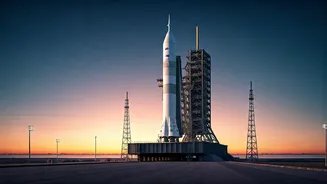
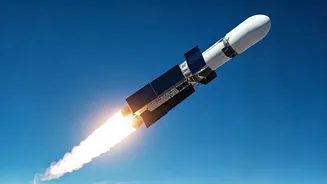
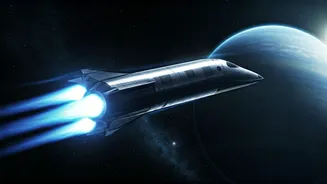
SpaceX's Starship represents a paradigm shift in launch capabilities that could fundamentally alter how we approach missions to the outer solar system. Beyond its sheer lifting power, Starship offers two key innovations that make it exceptionally suitable for a Uranus mission. Firstly, its capacity for in-orbit refueling is a critical enabler. By allowing Starship to be refueled in space, it can accumulate sufficient propellant to embark on faster interplanetary trajectories, a feat impossible for rockets that must carry all their fuel from Earth’s surface. While this capability is yet to be fully demonstrated, ongoing Starship tests are expected to validate it, opening up unprecedented speed possibilities for reaching distant destinations. Secondly, Starship itself can be repurposed as an aerobraking shield. Researchers have explored modifying Starship’s robust thermal protection system, designed for atmospheric re-entry on Earth and Mars, to decelerate the probe within Uranus’ atmosphere. This would eliminate the need for the Starship to separate after its initial boost, instead accompanying the probe and using its heat shield to slow down from interplanetary velocity, allowing it to enter orbit efficiently.
Halving the Journey Time
The combined application of Starship’s in-orbit refueling and its potential use as an aerobraking shield could dramatically reduce the transit time to Uranus. Calculations suggest that this integrated approach could cut the journey to approximately six and a half years, a remarkable feat that would eliminate the need for any gravitational assists from other planets. This accelerated travel time offers significant advantages, even accounting for the added complexity of taking a Starship along for the ride. By halving the travel duration, the overall operational costs of the mission would be substantially reduced, making a flagship mission to Uranus more feasible and sustainable. This innovation addresses the long-standing challenge of distance that has historically made such ambitious undertakings prohibitively expensive and lengthy.
Future Uncertainties Loom
Despite the exciting prospects offered by Starship, the realization of a Uranus mission remains contingent on several critical factors, including funding and timely development. While the UOP mission is a high priority according to the Decadal Survey, securing the necessary financial backing from NASA is far from guaranteed, especially amidst ongoing organizational flux. Furthermore, Starship’s aerobraking capability for an ice giant’s atmosphere is still theoretical and requires further validation. If the crucial launch windows in the 2030s are missed, the next optimal opportunity would not arise until the mid-2040s, potentially leaving a nearly 70-year gap between missions to this scientifically vital world. Enthusiasts of planetary science and space exploration are hopeful that the relevant agencies will overcome these challenges and support a return to Uranus, whether through Starship technology or other advancements.