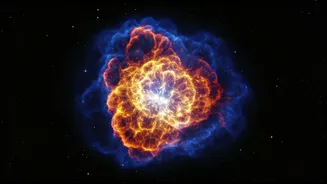








Hidden Cosmic Engines
Galaxy clusters, immense structures containing hundreds or even thousands of galaxies, are crucial for astronomers to study. Within these clusters, galaxies are immersed
in a superheated gas, emitting X-rays that can penetrate the cosmic dust. The Chandra X-ray Observatory is specifically designed to detect these X-rays and create detailed maps. This recent work reveals the intricate activity occurring within these clusters. These observations demonstrate how various processes are at play. Analyzing the distribution and intensity of X-rays allows scientists to identify the location of black holes and the extent of the hot gas. Chandra's data assists in observing the dynamic interactions and the movement of matter throughout galaxy clusters, providing a comprehensive understanding of these celestial environments.
X-Ray Mapping Revelations
The new X-ray mapping from Chandra allows astronomers to peer into previously unseen aspects of galaxy clusters. The X-ray images, created from the data collected, provide a unique perspective on the composition and behavior of these structures. The data facilitates the tracking of the movement of hot gas, the identification of shock waves caused by colliding galaxies, and the location of black holes. The X-ray mapping is used to create highly detailed images that reveal the distribution and density of the hot gas permeating the clusters. It helps to observe the effects of powerful events, such as supernova explosions and the activity of supermassive black holes. The X-ray analysis provides essential information on the energy and distribution of matter in the clusters. The X-ray data enables detailed investigations and reveals the inner workings of these massive structures.
Why New Views Matter
The insights gained from Chandra's new X-ray mapping are crucial for advancing our understanding of the universe. Studying galaxy clusters offers valuable information regarding galaxy formation, evolution, and the distribution of dark matter and dark energy, which are crucial components of the cosmos. The research provides a look into the ways galaxies interact and affect each other, including mergers and the exchange of matter. The study of the hot gas in these clusters contributes to understanding the effects of feedback processes, such as those driven by supermassive black holes. By analyzing the data, scientists can refine their models of the universe, improving its parameters and predictions. These improvements lead to a deeper comprehension of cosmic evolution and the dynamics of the universe.