







A Stellar Mystery
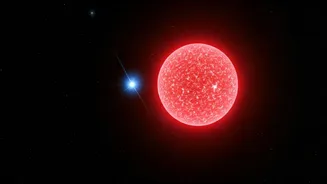
Betelgeuse, a red supergiant star, has captured the attention of astronomers for years. Its unpredictable behavior has fueled numerous investigations,
with researchers seeking to understand its inner workings and ultimate fate. One persistent theory involved the presence of a companion star, a celestial body orbiting Betelgeuse, which could influence its characteristics. Though difficult to directly observe, evidence hinted at the companion's existence. The Hubble Telescope, with its unparalleled observational capabilities, was instrumental in exploring this possibility. Its advanced instruments allowed scientists to collect and analyze data, searching for clues that could confirm or refute the hypothesis.
Hubble's Unveiling
Through sophisticated observations, the Hubble Telescope detected a distinct wake emanating from Betelgeuse. This wake, which is a trail of material, provided a significant clue to the presence of an unseen companion. It’s theorized that the companion star's gravitational influence caused this trail, distorting the space around Betelgeuse. The wake’s shape and behavior gave researchers valuable information about the companion star's position, orbit, and potential impact on its host star. Using detailed measurements, scientists were able to estimate various orbital parameters. These observations provided compelling evidence to support the idea of a companion star, deepening understanding of the dynamic interactions within the Betelgeuse system.
Confirming Theories
The Hubble Telescope's findings provided confirmation to the long-held theory of a companion star. The detection of the wake provided direct evidence, which supported previous indirect data. These results significantly strengthened existing models of the star's behavior, offering a fresh perspective on its evolution. Researchers can now incorporate this information into their simulations and models, improving their ability to predict the future of Betelgeuse. This confirmation marked a crucial step in unraveling the mysteries of Betelgeuse. It showed that complex systems can exist even in extreme environments. The data further emphasizes how critical space-based observatories are in expanding our horizons.
Implications and Future
The discovery has wide-ranging implications for astrophysical research. First and foremost, it helps us improve our knowledge of binary star systems. It also facilitates studies of stellar evolution by revealing how companion stars affect a larger star. By studying the companion star's influence, researchers gain crucial insights into the processes which might lead to explosions, such as supernovas. Future studies will involve tracking any changes within the wake. Using these observations, researchers may gain a deeper understanding of the interaction between the stars. The observations also underline the importance of continuous investigation.