




Gravity Transition Gear
As the Artemis 2 mission nears its conclusion, the four intrepid astronauts are meticulously preparing for their return to Earth. A key focus on their eighth
day in space involved a critical test of a specialized garment designed to aid their transition back to Earth's gravity. This innovative outfit, worn beneath the standard Orion Crew Survival System suit, is engineered to stabilize astronauts' blood pressure and circulation. Extended periods in microgravity can lead to orthostatic intolerance, a condition characterized by dizziness and lightheadedness upon standing. The garment employs targeted compression on the lower body to actively support blood flow, mitigating these post-spaceflight effects and ensuring a smoother re-acclimatization to terrestrial conditions. The crew's evaluation of this advanced system is vital for ensuring astronaut well-being on future deep space expeditions.
Manual Piloting Showcase
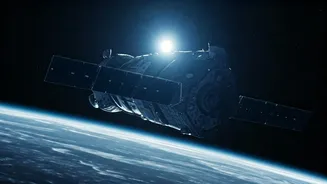
Beyond managing the physiological challenges of re-entry, the Artemis 2 crew executed a remarkable demonstration of manual piloting prowess. This involved disengaging the spacecraft's autopilot and directly guiding the Orion vessel toward Earth. The astronauts skillfully fine-tuned the ship's trajectory, maneuvering it to achieve a specific tail-to-Sun altitude. This precise control is essential for managing the spacecraft's thermal environment and optimizing power generation during the critical return phase. Having performed a similar maneuver earlier in the mission, this latest demonstration underscores the astronauts' proficiency and the Orion spacecraft's readiness for human-piloted deep space travel, building confidence for missions with longer communication delays.
Mission Milestones and Future
The Artemis 2 mission, slated for its November 2024 launch, represents a monumental leap in human space exploration, marking the first crewed journey to the lunar vicinity since the Apollo era concluded in 1972. This mission is not merely a test flight; it's a foundational step towards NASA's ambitious goals of establishing a sustained human presence on the Moon and ultimately venturing to Mars. The successful manual piloting tests are paramount, providing an essential layer of redundancy and safety for future voyages where immediate ground control is not feasible. This mission also serves as an invaluable proving ground for novel technologies and operational procedures that will pave the way for subsequent Artemis missions, including the historic landing of the first woman and the next man on the lunar surface.