





Tiny Molecule, Big Data
The digital universe is expanding at an exponential rate, straining current data storage technologies. Researchers are looking beyond silicon to biological
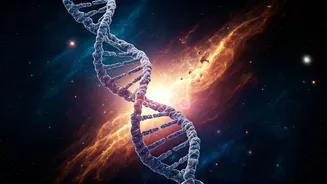
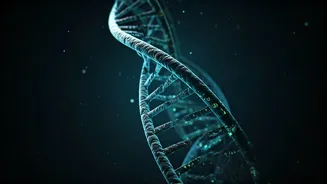
molecules, specifically DNA, for a solution. DNA offers an extraordinary capacity to hold vast amounts of information within an incredibly small volume and can endure for millennia – a testament to its robustness, as evidenced by DNA fragments recovered from millions of years ago. A novel approach introduces DNA nanostructures that act as physical data markers. When these structures pass through a miniature sensor, machine learning algorithms interpret subtle electrical signals generated by their unique shapes. This allows for the reconstruction of text and messages with remarkable accuracy. This method bypasses the often slow and expensive process of DNA sequencing, offering a faster, more cost-effective, and scalable alternative for storing data. This breakthrough points towards a future where monumental datasets, from scientific archives to cultural heritage, can be preserved compactly and efficiently, consuming minimal space and energy.
Molecular Encryption Unveiled
Beyond mere storage, DNA is emerging as a powerful tool for securing information. Researchers are engineering intricate DNA origami structures, essentially folded DNA strands that form precise two- and three-dimensional shapes. In this advanced encryption technique, data isn't stored as simple bits or characters but is intricately encoded within the specific arrangement and patterns of these nanoscale structures. This creates a sophisticated molecular code that is exceptionally difficult to decipher without the precise tools and reference patterns. To access the encrypted information, a specialized super-resolution microscopy technique is employed, allowing for the visualization of individual DNA structures with extreme precision. Subsequently, machine learning software analyzes thousands of these molecular images, grouping similar patterns and translating them back into the original message. Without the correct decoding framework, these patterns are virtually meaningless, providing an inherent layer of security. This method significantly expands the number of potential molecular codes, making unauthorized decryption exceedingly challenging. The ability to embed information within three-dimensional DNA structures further enhances complexity and security for each molecular key.
Synergy of Storage and Security
The combined insights from these studies demonstrate DNA's dual role as both a remarkably dense storage medium and a sophisticated platform for nanoscale information security. One technique excels in rapid, electronic-style data retrieval from molecular structures, while the other showcases how the intrinsic patterns of these molecular arrangements can serve as encrypted data containers. Future DNA-based systems hold the promise of supporting ultra-dense storage for critical information, including scientific findings, medical histories, and extensive cultural archives. Molecular encryption could offer novel security solutions for sensitive data in environments where traditional electronics falter, such as in extreme temperatures, high radiation zones, or for extremely long-term preservation needs. This research highlights a significant convergence of biology, materials science, computation, and electronics. By treating DNA as both a biological entity and an information conduit, scientists are pioneering new methods for storing, safeguarding, and accessing data at scales far beyond the capabilities of current digital devices, promising greater durability and density.