



Cosmic Dawn Revealed
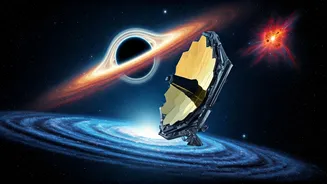
The James Webb Space Telescope (JWST) is pushing the boundaries of our cosmic view, consistently breaking its own records by discovering the farthest known
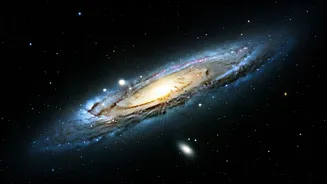
galaxies. These observations are providing unprecedented insights into the universe's infancy, mere hundreds of millions of years after the Big Bang. One particularly astonishing discovery revealed a galaxy containing the oldest oxygen ever detected, challenging existing models of early stellar evolution and galactic chemical enrichment. Furthermore, JWST has identified what may be the earliest galaxy ever observed, a 'puzzling' object that defies current cosmological timelines and prompts a re-evaluation of how quickly structure formed in the nascent universe. These early galaxies, existing in massive groups so hot they defy theoretical expectations, suggest that the universe's formative stages were far more dynamic and complex than previously imagined.
'Vampire Stars' & Early Light
JWST has shed light on the phenomenon of 'forever young' vampire stars, celestial bodies that appear to have remained youthful despite the universe's vast age. These stars are thought to be fueled by the material stripped from companion stars, a process that can artificially extend their lifespans and skew our understanding of stellar evolution. In a related vein, astronomers have observed 'time-warped' supernovas whose light exhibits peculiar properties, appearing to have both reached and not yet reached Earth simultaneously. This intriguing effect, while not a literal time paradox, highlights the complex ways light travels through the expanding and distorting fabric of spacetime. JWST has also potentially captured the earliest supernova ever detected, offering a glimpse into the explosive deaths of the universe's first massive stars, and may have even identified the very first stars to ignite, providing crucial data points for models of cosmic reionization.
Black Hole Dynamics
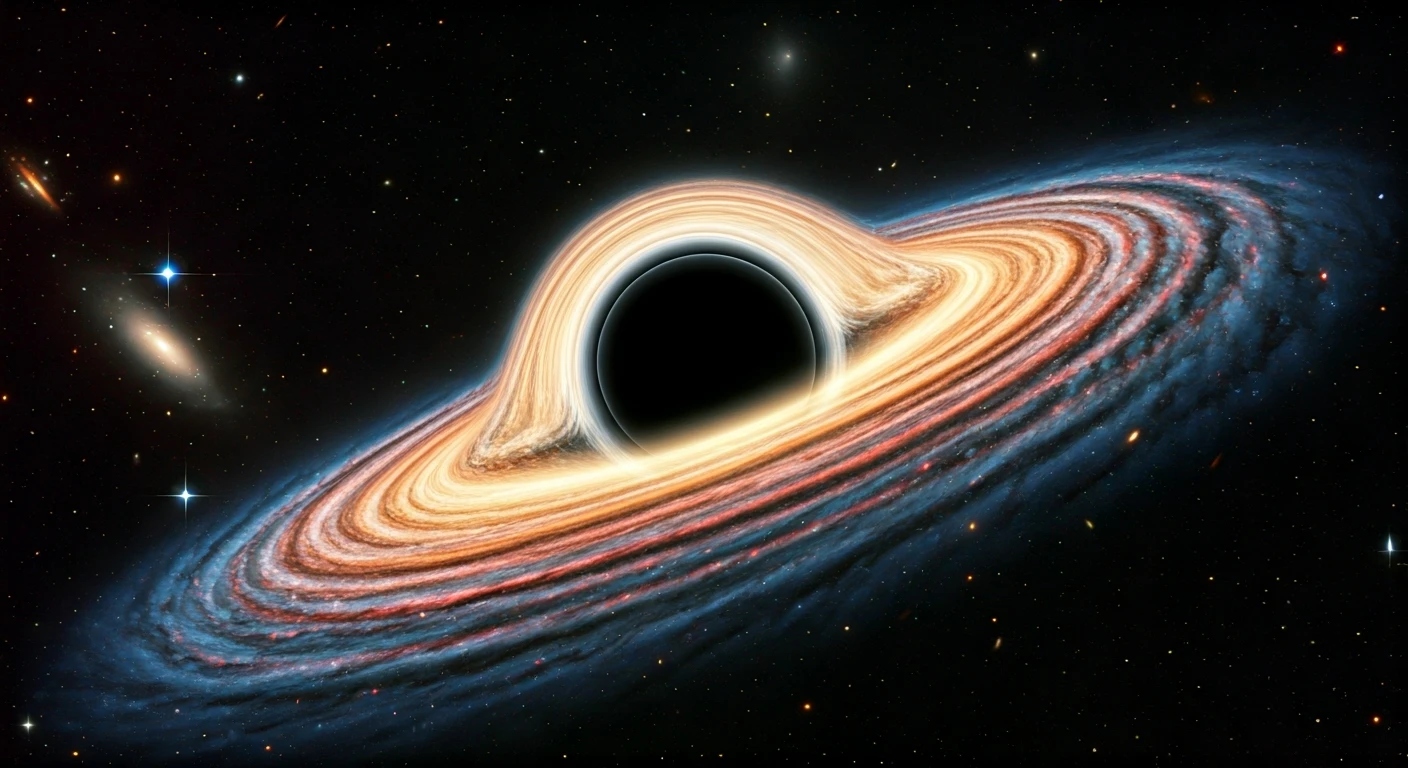
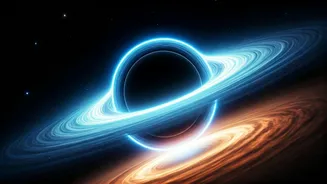
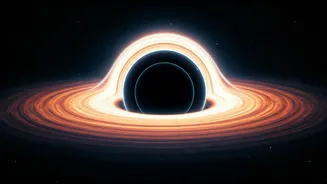
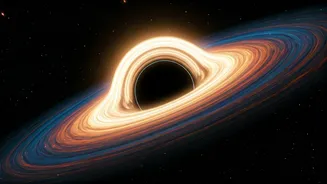
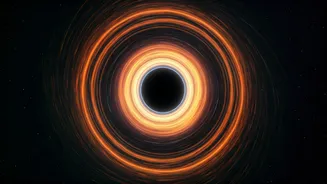
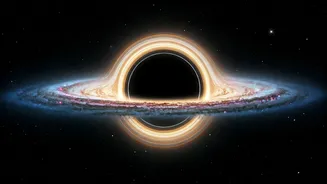
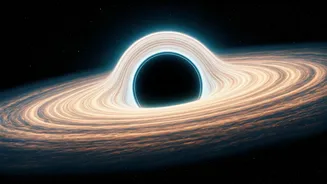
The James Webb Telescope is providing a startling new perspective on black holes, revealing phenomena that are overturning established astrophysical theories. It has confirmed the existence of a supermassive black hole moving at an incredible speed of 2 million miles per hour, fleeing its host galaxy. This dramatic escape is an unexpected outcome and suggests that chaotic galactic interactions or powerful energetic events can eject these massive objects. JWST has also observed black holes emerging from what researchers describe as 'cocoons' near the dawn of time, indicating a more rapid and complex formation process for these enigmatic entities than previously theorized. Moreover, the telescope's sharpest-ever images of the edge of a supermassive black hole are offering unprecedented details about the accretion disks and event horizons of these cosmic behemoths, aiding in the study of general relativity in extreme environments. The telescope's findings are leading to a 'real revolution' in our understanding of the biggest and oldest black holes in the universe.
Cosmic Puzzles & New Models
Beyond individual celestial objects, JWST's observations are prompting a fundamental reconsideration of our cosmological models. The standard model of cosmology, after a massive 6-year study, appears to hold up, yet numerous other theoretical frameworks are being challenged. In fact, 30 different models of the universe have been proven wrong by the final data from JWST's groundbreaking work. Astronomers have also detected a 'totally unexpected' galaxy that defies current understanding of the early universe, and JWST has spotted the Milky Way's long-lost 'twin,' fundamentally altering our view of galactic evolution. The discovery of a gigantic, wobbling black hole jet challenges our assumptions about galactic dynamics, and a 'superkilonova'—a double star explosion—is puzzling scientists with its unprecedented energy output. Additionally, a record-breaking 'dark object' hidden within a warped 'Einstein ring' at a distance of 10 billion light-years presents a novel cosmic enigma. These diverse and often surprising findings suggest that our current understanding of the universe may be deeply flawed, possibly requiring a revision that views space itself as more akin to a 'sticky' fluid rather than an empty void.