
Dark Matter's Enigma
Dark matter, an invisible substance, makes up approximately 85% of the total mass of the universe. It neither emits nor absorbs light, making it exceptionally
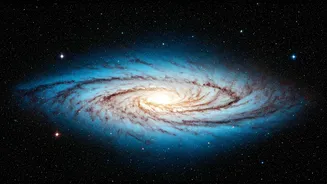
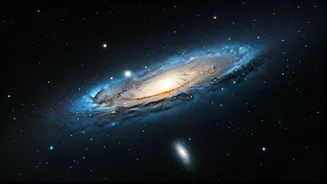
difficult to detect directly. Its existence is inferred from gravitational effects on visible matter, such as the rotation of galaxies and the bending of light. Understanding dark matter is crucial for comprehending the formation and evolution of the universe. The quest to understand its nature is one of the most significant challenges in modern astrophysics. Scientists employ various methods and instruments to study its influence, hoping to uncover its composition and properties. The James Webb Space Telescope's advanced capabilities offer a new window into exploring this mysterious component of the cosmos, providing an unprecedented perspective on the structure of the universe.
JWST: A Powerful Tool
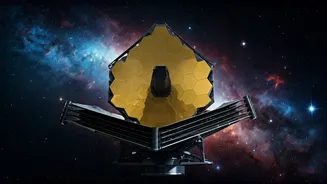
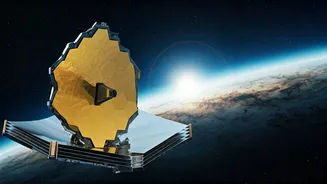
The James Webb Space Telescope, a successor to the Hubble Space Telescope, is the most powerful space telescope ever built. Its advanced infrared capabilities enable it to peer through dust clouds and observe distant galaxies with unparalleled detail. The JWST's large mirror collects more light, allowing it to see fainter objects and farther distances than previous telescopes. It operates at extremely low temperatures to reduce interference and provide the clearest possible images. Its instruments are designed to analyze the light from galaxies, allowing scientists to study their composition, motion, and the effects of dark matter. The JWST's ability to observe in the infrared spectrum allows scientists to see light that is invisible to the human eye, offering new insights into the early universe and the formation of galaxies.
Mapping Warped Galaxies
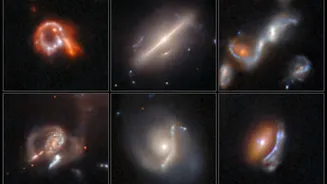
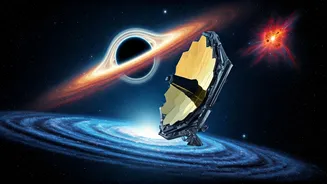
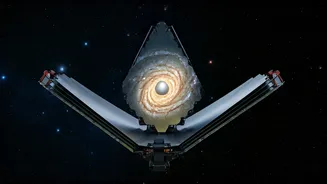
Astrophysicists are using the JWST to study how dark matter influences the distribution of galaxies and warps the fabric of space-time. Massive objects, including dark matter, bend the path of light, a phenomenon called gravitational lensing. By analyzing the distorted images of distant galaxies, scientists can map the distribution of dark matter. These distortions act as a cosmic magnifying glass, allowing us to see details otherwise obscured by vast distances. The study of gravitational lensing provides a unique opportunity to probe the structure of dark matter and understand how it interacts with visible matter. The JWST's high resolution and sensitivity are key to accurately measuring these distortions and creating a more detailed map of dark matter.
Unveiling Dark Matter
The ultimate goal of this research is to unveil the secrets of dark matter and understand its properties. By creating a detailed map of dark matter distribution, scientists hope to gain clues about its nature and composition. This could involve identifying the fundamental particles that make up dark matter. The JWST's observations can also help refine cosmological models and improve our understanding of the universe's evolution. The findings may shed light on the formation of galaxies, the large-scale structure of the cosmos, and the ultimate fate of the universe. This ambitious project aims to answer fundamental questions about the nature of reality and our place within the vastness of space. As the JWST continues to gather data, scientists expect new insights that will reshape our understanding of the universe.