





Einstein's Prediction
Albert Einstein's theory of general relativity, a cornerstone of modern physics, predicts that massive objects like black holes significantly warp the fabric
of spacetime. This concept suggests that the presence of such colossal entities causes a curvature in spacetime, the four-dimensional continuum that encompasses three spatial dimensions and time. The effects of this curvature are dramatic, influencing the motion of objects and the propagation of light around these extreme gravitational environments. Although the theory predicted this effect, directly observing a black hole twisting spacetime to confirm the prediction had remained elusive for many years, until now. Recent observations have provided empirical evidence for this theory, offering compelling support for the foundational principles of general relativity.
Observational Breakthrough
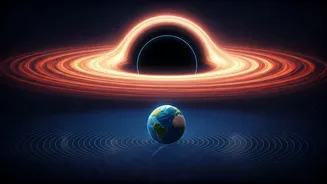
The breakthrough in observing a black hole twisting spacetime was achieved through cutting-edge astronomical techniques. Scientists utilized advanced telescopes and sophisticated data analysis methods to gather and interpret light from the vicinity of a black hole. This process involved analyzing the patterns of light emitted by matter as it was being pulled toward the black hole. As matter spirals into a black hole, it forms an accretion disk, a swirling disk of gas and dust. This material is superheated and emits intense radiation, allowing astronomers to trace its path and observe how it is affected by the black hole's gravity. By carefully analyzing the light from the accretion disk, researchers were able to discern the warping of spacetime caused by the black hole.
Confirming Einstein's Theory
The observations directly confirmed the predictions made by Einstein's theory of general relativity. The data revealed that the black hole was indeed twisting spacetime as predicted, providing concrete evidence of the theory's validity. This confirmation has significant implications for our understanding of gravity and the universe's fundamental nature. The observed warping of spacetime was consistent with the theoretical models of general relativity, further solidifying the theory's position as a robust explanation of gravitational phenomena. The results served as a critical test, strengthening the belief in the accuracy and far-reaching implications of Einstein's groundbreaking work. The validation from these observations inspires further investigations into black holes and their effects on the cosmos.
Implications and Future
This discovery offers fresh perspectives into the dynamics of black holes. The new observations not only substantiate Einstein’s theory, but also offer a deeper understanding of black hole behavior. Scientists are now equipped to model and simulate these complex gravitational environments with greater accuracy. This will lead to improvements in our understanding of the universe. Future research will build upon these findings to explore the properties of black holes and the behavior of matter under extreme gravitational conditions. This observation is a significant stride towards unraveling the mysteries of these celestial behemoths, further enhancing the quest to explore and understand the universe.