
Dark Matter Unveiled
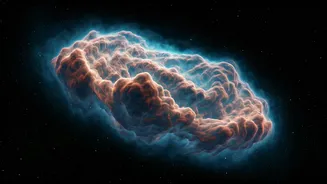
Astronomers have long sought to understand dark matter, the mysterious substance that makes up a significant portion of the universe's mass. The Hubble
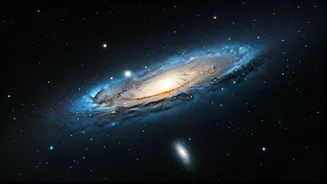
Space Telescope recently observed a starless dark matter cloud, providing a unique opportunity to study this enigmatic material. This cloud, devoid of stars, offers a cleaner view, allowing scientists to focus on dark matter's properties without interference from stellar activity. The detection of this cloud has opened a new window into the dark universe, facilitating detailed studies of dark matter's distribution and behavior. Understanding the structure and characteristics of this cloud could offer clues about how galaxies form and evolve over vast cosmic timescales.
Betelgeuse's Companion
In addition to the dark matter cloud, the Hubble Telescope has also been studying Betelgeuse, a red supergiant star. The telescope detected the wake of a hidden companion star of Betelgeuse, confirming a long-held scientific theory. This observation provides evidence that Betelgeuse, thought to be a single star for a long time, has a companion. The interaction between Betelgeuse and its companion plays a crucial role in the evolution of both stars. The discovery and confirmation have implications for the study of binary star systems and their impact on stellar life cycles. Further research is needed to determine the companion's characteristics and the full implications of its interaction with Betelgeuse.
Cosmic Implications
The findings from the Hubble Telescope, including the starless dark matter cloud and the Betelgeuse companion star, have significant implications for astrophysics. These observations support existing models while also posing new questions for investigation. The study of dark matter and the dynamics of binary star systems contribute to a broader understanding of how the universe functions, including galaxy formation and stellar evolution. With ongoing research and advancements in space-based telescopes, scientists hope to further unravel the complexities of the cosmos, providing an even more profound comprehension of the universe's past, present, and future.