
An Unexpected Duration
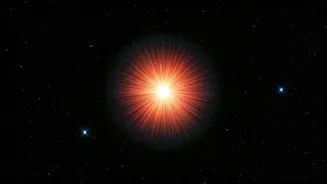
The observed gamma-ray burst, a brief yet intense flash of high-energy light, has been labeled as an anomaly due to its unprecedented longevity. Gamma-ray
bursts, typically lasting from a fraction of a second to a few minutes, are known as the most luminous events in the cosmos. This particular burst, however, persisted for approximately seven hours, challenging astronomers' expectations and current scientific models. Its extended duration has ignited intense interest within the scientific community, prompting re-evaluations of the standard understanding surrounding these powerful cosmic explosions.
Faraway Origins
This extraordinary gamma-ray burst originated from a source located roughly 8 billion light-years away. Considering its distance, the burst occurred in the early universe, allowing astronomers to observe events from the past. The light emitted during the burst traveled for billions of years to reach Earth, providing a glimpse into the evolution of the cosmos. This makes the observation particularly valuable, offering insights into the behavior of the early universe and the types of events that unfolded during that time.
Rethinking Astrophysics
The extended duration of the burst has prompted the need to reassess established models in astrophysics. The characteristics of gamma-ray bursts, like their duration, are key to understanding their origins. Typically, these bursts are thought to be caused by the collapse of massive stars or the collision of neutron stars. However, the lengthy duration of this recent burst does not align with traditional explanations, pushing scientists to explore new mechanisms and alternative models. This unexpected discovery could drive advancements in the understanding of how the universe's most powerful events occur.
Decoding Cosmic Mysteries
Analyzing the gamma-ray burst and its afterglow holds the potential to unlock crucial information about the energetic processes at play. The light from such events contains clues about the environment where they originate. Data from this burst, like its energy spectrum, composition, and temporal evolution, could reveal details about the nature of the star or system involved, as well as the surrounding cosmic environment. This ongoing analysis aims to unveil the specific mechanisms responsible for generating such a prolonged and intense emission, potentially reshaping our understanding of the universe's energetic phenomena.
Ongoing Research Efforts
Teams of astronomers are currently working on a variety of methods to study this burst in depth. This involves gathering data from numerous ground-based and space-based telescopes and performing detailed computer simulations. The goal of combining these various observations and simulations is to build a complete picture of the burst, offering valuable insights into its origin. Scientists intend to use different types of telescopes to observe the burst, including those that detect gamma rays, X-rays, and optical light, allowing for a comprehensive view of the event. They will use this collected information to construct detailed models of the burst, testing them against existing theories and proposing new explanations for the observed phenomena.
Future Implications
This discovery of the long-lived gamma-ray burst is poised to have considerable implications on future research and knowledge of the universe. The unexpected findings will shape future studies on cosmic events. Astronomers can expect a new era of research, leading to new models, and a deeper grasp of the cosmos. As telescopes and observation tools advance, scientists anticipate discovering even more unique events, expanding our understanding of the universe's powerful phenomena. This discovery signifies a significant turning point in our understanding of the cosmos and the violent processes that shape it.