








A New Era of Defense
In the rapidly evolving digital arena, cybersecurity has taken center stage, particularly following the recent emergence of Anthropic's Claude Mythos AI.
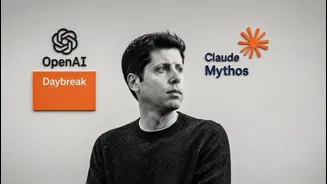
This powerful model has sparked significant global concerns regarding its potential to compromise software and operating systems, prompting governments and corporations alike to re-evaluate online security. In response, OpenAI has unveiled its own formidable cybersecurity initiative, christened Daybreak. This project represents OpenAI's proactive stance in the ongoing AI-driven arms race, aiming to develop robust and resilient cyber defenses. CEO Sam Altman announced Daybreak, framing it as a dedicated effort to accelerate cyber defense strategies and ensure the continuous security of software systems. OpenAI's approach emphasizes collaboration, inviting a wide array of companies to partner in strengthening their cybersecurity postures.
Daybreak's Architectural Foundation
The core philosophy behind OpenAI's Daybreak initiative is built upon the principle of 'resilience by design.' This means fostering an environment where cybersecurity is intrinsically embedded into the development and operational lifecycle, rather than being an afterthought. As artificial intelligence continues its relentless advancement, so too do the potential threats it can pose. While AI offers powerful tools for defenders to pinpoint weaknesses and verify solutions, these same capabilities could be exploited by malicious actors. Daybreak aims to harness the dual nature of AI by integrating OpenAI's existing sophisticated AI models with the advanced agentic functionalities of Codex, its renowned coding agent. This fusion equips cybersecurity professionals with a potent suite of tools for a multitude of tasks, including thorough code reviews, predictive threat modeling, rigorous patch validation, and in-depth analysis of dependency risks.
Distinguishing from Claude Mythos
While an initial glance might suggest a strong resemblance between OpenAI's Daybreak and Anthropic's Claude Mythos, crucial distinctions set them apart. Anthropic's Project Glasswing exclusively utilizes Claude Mythos, an AI model not yet widely released to the public. In contrast, OpenAI's Daybreak draws upon a spectrum of its advanced AI models, including notably GPT-5.5 and a specialized GPT-5.5-Cyber variant. Another significant divergence lies in their accessibility and collaboration strategies. As articulated by Sam Altman, OpenAI is actively seeking broad partnerships, engaging with numerous companies to implement Daybreak. Indeed, OpenAI has already publicized collaborations with prominent entities like Cloudflare, Oracle, and Cisco. This contrasts with Anthropic's more exclusive approach, where Claude Mythos, through Project Glasswing, has been made available to a select group of approximately 40 organizations, though reports of unauthorized access have surfaced.
Operational Modalities of Daybreak
OpenAI has delineated the operational framework of Daybreak to empower teams in proactively identifying and rectifying vulnerabilities, streamlining remediation efforts, automating threat detection and response mechanisms, and establishing appropriate access controls for diverse operational workflows. Within the Daybreak suite, OpenAI has outlined three distinct model configurations. The default option, GPT-5.5, provides general-purpose AI capabilities for developmental, knowledge-based, and everyday work, fortified with standard safety protocols. For specialized defensive operations within secure, authorized environments, GPT-5.5 with Trusted Access for Cyber is recommended. This variant is tailored for tasks such as secure code analysis, vulnerability assessment, malware investigation, and the engineering of detection systems. The most sophisticated tier, GPT-5.5-Cyber, is engineered for highly specialized, authorized workflows requiring stringent verification and account-level security controls, offering preview access for authorized red teaming, penetration testing, and controlled validation exercises.
Building on Prior Innovations
The Daybreak initiative represents a significant evolution, building directly upon OpenAI's previous advancements in the cybersecurity domain. This new project integrates and expands upon the capabilities demonstrated in earlier releases. For instance, the company highlighted its April release of GPT-5.4-Cyber, an AI model that had demonstrably contributed to resolving over 3,000 reported software vulnerabilities. This track record underscores OpenAI's commitment to tangible improvements in software security. By leveraging and refining the technologies developed in these prior efforts, Daybreak is positioned to offer even more comprehensive and effective solutions for the complex challenges faced in modern cybersecurity, aiming to not only identify but also to proactively mitigate a wider range of threats.