







Dark Matter's Secrets
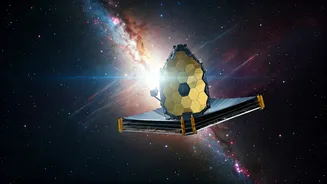
JWST is poised to become an instrumental tool in the search for dark matter, a mysterious substance believed to constitute a significant portion of the universe's
mass. Scientists are utilizing JWST's advanced capabilities to observe and analyze distant galaxies, searching for any unusual patterns or anomalies that could hint at the presence and influence of dark matter. This telescope can peer through cosmic dust clouds that obscure visible light, allowing it to study the early universe and the formation of galaxies. The high sensitivity and resolution of JWST allow astronomers to observe faint objects and analyze the spectra of light from distant galaxies. These data can provide valuable clues about the distribution and properties of dark matter, potentially validating theoretical models or revealing new insights. Further studies will provide a better understanding of the invisible mass that shapes the cosmos, thereby refining our understanding of how the universe is structured.
Runaway Black Hole!
JWST has also unveiled an extraordinary observation: a runaway supermassive black hole hurtling through space at an astonishing 2.2 million miles per hour. This rare discovery challenges our previous understanding of how black holes interact with their surroundings and offers a glimpse into the dynamic processes shaping galaxies. Observing this runaway black hole enables scientists to study its trajectory and the effects it has on its environment. Understanding its movement will help clarify the mechanisms that can cause such immense objects to escape their host galaxies. Through this telescope's capabilities, scientists are analyzing the radiation emitted by the black hole and its surrounding environment to understand the forces at play. This includes studying the interaction between the black hole and the interstellar medium, which will contribute to our understanding of the evolution and distribution of galaxies and the role of black holes within them.