



Hubble's Orbital Marvel
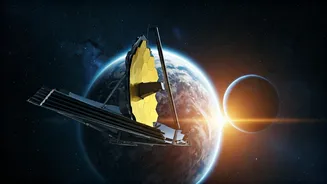
Orbiting nearly 300 miles above Earth, the Hubble Space Telescope has been a revolutionary instrument since its 1990 launch, fundamentally altering our
perception of the universe. It navigates our planet at an astonishing speed, completing a full revolution every 95 minutes. During these swift orbits, Hubble meticulously captures awe-inspiring images across a wide spectrum of light, from ultraviolet to near-infrared, providing unparalleled insights into celestial bodies and phenomena. Its continuous operation has yielded a vast archive of visual data, essential for astronomical research and public fascination with space.
Butterfly Nebula's Glow
Located approximately 4,000 light-years away in the constellation Scorpius, the NGC 6302 planetary nebula, often referred to as the Butterfly Nebula, presents a stunning spectacle. Hubble's advanced optics have revealed the intricate details of this celestial formation, which represents the final, dramatic stages of a star's life. This vast, glowing cloud of gas spans over 3 light-years and emits intensely in ultraviolet light, casting vibrant colors and complex structures onto the surrounding cosmic environment. The nebula's formation is a testament to the powerful forces at play during stellar death, creating intricate patterns that mesmerize observers.
Pillars of Creation
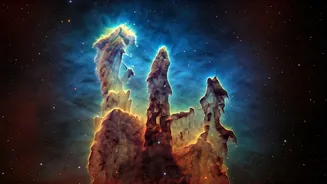
Within the Eagle Nebula, roughly 7,000 light-years from Earth, lie the iconic Pillars of Creation. These monumental columns of gas and cosmic dust are not merely visually striking; they are vital stellar nurseries where new stars are actively forming. Underneath the intense ultraviolet radiation from nearby massive stars, these towers exhibit brilliant hues: blue signifies oxygen, red indicates sulfur, and green represents a combination of hydrogen and nitrogen. Hubble's ability to capture these structures in such detail has provided invaluable data for understanding the complex processes of star birth and the dynamics within nebulae.
Globular Cluster NCG 1841
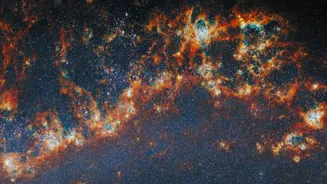
NCG 1841, a globular cluster, is situated within the Large Magellanic Cloud, a satellite galaxy of our own Milky Way, approximately 162,000 light-years distant. Globular clusters are often likened to cosmic relics or 'fossils' because they contain some of the universe's oldest stars. Their composition and structure offer crucial insights into the very early stages of star formation within galaxies, providing a window into the universe's nascent history. Studying NCG 1841 allows astronomers to piece together the evolutionary timeline of galactic development.
Little Dumbbell Nebula
In celebration of Hubble's 34th anniversary in orbit, an image of the Little Dumbbell Nebula (M76) was released, vividly illustrating the terminal phases of a dying star. This planetary nebula formed when a red giant star shed its outer layers before collapsing into a compact white dwarf. Hubble's observation reveals a unique, hourglass-like form, characterized by a luminous central ring and expanding gaseous lobes. This display of cosmic artistry highlights the beauty found in stellar demise and the intricate processes that shape the universe's end stages.
Saturn's Seasonal Hues
Captured in July 2020, an ethereal image of Saturn by the Hubble Space Telescope revealed subtle atmospheric shifts due to seasonal changes. The photograph, taken during the planet's northern hemisphere's summer, displayed a distinct reddish haze. This coloration is attributed to increased solar radiation and dynamic atmospheric activity. In stark contrast, Saturn's southern hemisphere exhibited cooler blue tones, indicative of winter conditions. This detailed visual record is instrumental in enhancing our understanding of the evolving weather patterns, storms, and overall atmospheric dynamics of gas giants within our solar system.