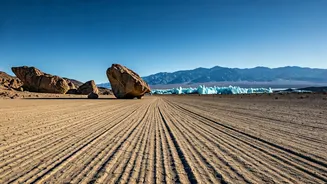








Mysterious Rock Movement
The Racetrack Playa in Death Valley National Park is home to a captivating geological mystery: rocks that appear to move across the flat, dried-up lakebed,
leaving behind trails in their wake. For many years, the cause of this phenomenon remained a puzzle, sparking numerous theories and scientific debate. The trails themselves offered clues, hinting at the direction of movement and the potential forces involved. Some trails are long and straight, indicating a steady, unidirectional push. Others are more erratic, suggesting a complex interplay of forces. The rocks themselves vary in size and weight, yet they all seem subject to the same unusual phenomenon, adding to the intrigue. Discovering the mechanism behind this motion has occupied geologists and other specialists. The elusive nature of the event complicated direct observation. Documenting the precise conditions under which rocks would move was particularly challenging due to the infrequent and unpredictable nature of the event.
The Ice Factor
The breakthrough in understanding the moving rocks came with the recognition of a critical factor: ice. Researchers found that under specific conditions, thin sheets of ice form on the playa's surface during winter nights. These ice sheets are not the usual kind; they are fragile and form during freezing temperatures and the subsequent thawing. As temperatures begin to rise during the day, these ice sheets start to melt. If the wind is just right, these melting ice sheets can be pushed across the slippery surface. It’s a delicate balance that provides the necessary conditions for rock movement. The combination of ice and wind creates a scenario where the rocks, embedded within or resting upon the ice, are gradually and subtly propelled across the playa's surface. The movement is usually slow, often only a few inches or feet at a time, but over time, these small movements accumulate, creating the distinctive trails that define the mystery.
Wind's Role in Motion
Wind is the second crucial element in the rock's movement. The ice sheets, once formed, need a gentle but consistent push to initiate and sustain the motion. The wind doesn't need to be strong; even light breezes can be enough. The wind's direction also plays a key role. It must blow in a way that aligns with the ice and the embedded rocks. The ice sheets act like a raft, and the wind serves as a sail. The interaction between the ice and the wind explains the variety of trail patterns found on the Racetrack Playa. Straight trails are often the result of steady, unidirectional wind, whereas the more erratic, curved trails result from shifting wind directions. Different wind speeds also affect the trails. Gentle winds produce slower, steadier movements, and stronger winds can lead to more rapid or erratic movements. The wind's role is not just about propulsion; it’s also about the consistency of motion, determining the path and distance covered by the rocks.
Unveiling the Mystery
By combining the knowledge of ice sheet formation and wind dynamics, scientists finally had the comprehensive explanation for the Death Valley rock movements. The study found the rocks embedded in ice sheets which, when melted under the right wind conditions, allowed them to slide. This understanding highlighted the complexity and delicate balance of environmental factors that allow this phenomenon to happen. It was a remarkable instance of interdisciplinary science, where geology, meteorology, and ice physics converged to solve a long-standing riddle. The revelation showed how even in the most extreme environments, such as Death Valley, subtle forces can shape the landscape. This scientific breakthrough exemplifies the persistence and creativity required in geological research.
Implications and Insights
The discovery has broader implications beyond just explaining the rock movements. It provides further insights into how geological processes work in extreme environments and demonstrates the importance of considering multiple interacting factors. The research underscores the sensitivity of these natural systems. The conditions have to be perfectly calibrated for this phenomenon to occur, highlighting how climate change or slight alterations to the environment could disrupt these processes. It helps scientists understand similar phenomena elsewhere, not just in Death Valley. It also serves as a reminder of the value of long-term observation and persistent investigation in scientific inquiry. Finally, it also allows scientists to understand planetary environments better. The findings contribute to a deeper appreciation of the planet's dynamic geological forces.