
Unveiling the Mystery
The Hubble Space Telescope, renowned for its exceptional observational capabilities, has made an important discovery related to the red supergiant star
Betelgeuse. The telescope's findings show evidence of a companion star trailing behind Betelgeuse. This companion star, previously undetected, has been hypothesized to exist for years. The observations from Hubble provide direct evidence, confirming earlier theories about the star's environment and behavior. This research builds upon previous scientific understanding, offering a more complete view of Betelgeuse and its hidden companion. The discovery is significant as it provides crucial information on how massive stars interact within binary systems, influencing their eventual evolution, and providing an insight into the final stages of a star's life.
Analyzing the Data
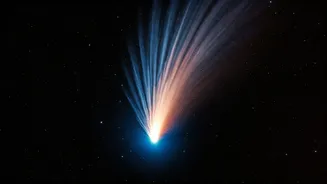
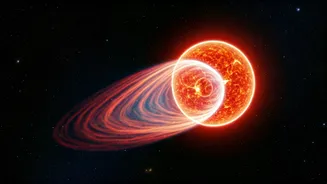
Using its advanced imaging capabilities, the Hubble Telescope examined the area surrounding Betelgeuse, capturing detailed images and data. Scientists analyzed these visuals, looking for telltale signs of interactions or disturbances in space. The data analysis revealed a wake, a trail of material, following behind Betelgeuse. This wake is formed by a hidden companion star moving through space, acting like a boat that leaves a wake in the water. The material in the wake is comprised of gas and dust ejected by the Betelgeuse system, providing insight into the ongoing processes within. The data analysis confirmed the existence of a companion star that influenced the giant star and its surroundings. The precision of the Hubble's instruments and the thoroughness of the analysis were critical in making this discovery.
Impact of Findings
The discovery of the companion star and the wake it produces has several key implications for understanding the lifecycle of stars. It gives a deeper insight into the complexities of binary star systems, where two stars orbit each other. These systems impact the evolution and eventual fate of stars, often in ways that differ from single stars. The new data helps scientists study how stars interact, transfer mass, and even undergo dramatic events like supernovae. The discovery also provides a better grasp on the mechanics of dust and gas dispersion around stars. Such processes contribute to our understanding of the universe's evolution and the formation of new stars and planetary systems. The findings also serve as a reminder of the universe’s complexity, showing new phenomena that can be detected through scientific advancements.
Future Research
This discovery opens avenues for further research into Betelgeuse and its hidden companion. Astronomers are eager to conduct more detailed observations, using Hubble and other powerful telescopes to refine their understanding. Scientists plan to study the companion star's characteristics more closely. Studying the companion’s orbit, size, and composition will reveal more about its relationship with Betelgeuse. The ongoing research will focus on studying the wake material to learn about the star's behavior and the interaction between the two stars. By investigating further, researchers hope to build a more comprehensive model of Betelgeuse's future. The new information will contribute to our understanding of stellar evolution, the formation of cosmic structures, and the behavior of the universe at large.