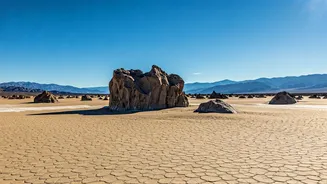

A Geological Puzzle
The 'sailing stones' of Death Valley National Park have presented a long-standing riddle. Located in the desolate Racetrack Playa, these rocks leave trails
that stretch across the flat, dried lakebed. The mystery has captivated scientists, geologists, and curious individuals worldwide, because it seemed impossible that something so heavy could move without human or animal intervention. These stones, weighing up to several hundred pounds, had been observed to move periodically, leaving behind clear paths. Despite numerous theories and investigations, the exact mechanisms behind this movement remained elusive for many years, fueling speculation and scientific inquiry. This enigmatic phenomenon of the Death Valley has challenged accepted scientific understanding for a long time.
Ice and Wind Forces
The scientific breakthrough revealed that the movement of the sliding rocks is the combined effect of several elements, primarily the presence of thin ice sheets and wind. It's not the wind acting alone, but rather a specific set of climatic conditions that facilitates the sliding. During the winter, when the temperatures drop, thin sheets of ice form on the playa's surface. As the ice melts and the sun warms up the area, the ice begins to break up into small, floating plates. Then, when the wind blows across the playa, it pushes the ice and the rocks frozen within, causing them to move across the mud surface. This interaction between the ice and the wind, along with the relatively smooth playa surface, is what enables the rocks to travel, leaving trails behind them.
Conditions for Movement
The environment's specific conditions are necessary for the rock movement to occur. The playa must have water, which then freezes to form the thin ice sheets, and that water must contain a unique combination of substances. The ice has to be just thin enough to allow the wind to have an effect but strong enough to remain intact as it pushes the rocks. Moreover, the wind's velocity and direction must align in such a way that the ice sheets, with the rocks, are carried across the surface. These conditions do not happen very often, thus the sporadic and unpredictable nature of the rock's movement, increasing the mystery's allure. This unique combination of factors reveals that the sliding rocks is a complex interaction of meteorological and geological features.
Decades of Study
Before the discovery, scientists had proposed a variety of theories, but many lacked sufficient evidence to explain the rocks' movement. Some researchers suggested that the wind alone was sufficient to push the stones. Others postulated that hidden magnetic forces or subterranean currents might be involved. Despite these theories, none fully accounted for the observed movement. The breakthrough came after years of meticulous observation and experimentation. Researchers used GPS devices to track the rocks' movement, noting the precise conditions under which they shifted. This intensive investigation and technological advancement enabled scientists to unveil the real dynamics behind the sliding rocks. As the mystery was finally solved, it was one of the most exciting developments in geology.
The Breakthrough Revealed
This specific study solved a problem that had puzzled scientists for decades. This groundbreaking discovery showcases the significance of combining innovative technology with meticulous, patient observation. The solution not only answered the immediate question of how these rocks travel, but also highlighted the complex geological processes at work in Death Valley. The research shows the interplay of climate, ice, and wind in sculpting the landscape, underscoring the dynamic nature of our planet. This investigation offers valuable insights into the ways in which natural forces can work together to shape and remodel landscapes over time. Furthermore, the findings serve as a reminder of how much more there is to explore and comprehend about the Earth.