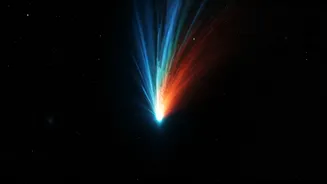







Comet Unveiled
The European Space Agency's (ESA) JUICE mission is currently making waves, and not just in the scientific community. The mission's NavCam has provided
the first breathtaking images of Comet 3I/ATLAS. These initial visuals offer a unique look at the comet's structure and activity. The images detail the comet's glowing coma, a cloud of gas and dust surrounding its nucleus, along with its plasma and dust tails stretching across space. These elements are key to understanding cometary behavior and their impact on the surrounding environment. This early data is critical for understanding the composition and the processes at work within the comet itself. Analyzing these images helps scientists to understand cometary processes such as sublimation and the ejection of dust and gas. These findings will significantly enrich our understanding of these celestial bodies.
JUICE Mission Goals
The JUICE (Jupiter Icy Moons Explorer) mission is not just about comets. It represents a larger quest to unravel the mysteries of Jupiter and its icy moons. This ambitious mission is designed to spend at least three years orbiting Jupiter, with the primary objective of studying the moons Europa, Ganymede, and Callisto. These celestial bodies are believed to have vast subsurface oceans, making them potential habitats for life. The mission will use advanced instruments to analyze the moons' surfaces and interiors, looking for evidence of water and other key compounds that could support life. The JUICE mission’s findings are expected to have a huge impact on our understanding of planetary formation, the habitability of icy moons, and the potential for life beyond Earth. The study of the comet is a bonus, providing crucial data that adds to the overall understanding of the solar system's components.
NavCam's Role
The NavCam (Navigation Camera) plays a crucial role in the JUICE mission. This camera is primarily responsible for helping the spacecraft navigate through space and accurately target its observations. While its primary function is navigation, it is also equipped to capture compelling images of various celestial objects, including the Comet 3I/ATLAS. These images are essential for scientific analysis. The NavCam’s high-resolution images provide scientists with a wealth of information about the comet's structure and dynamics. Detailed observations of the coma, the plasma tail, and the dust tail provide valuable insights into how these features evolve over time. The NavCam’s ability to capture these images is a testament to the advancements in space technology. The images taken by NavCam are providing a deeper look into the composition and behavior of the comet.
Cosmic Significance
The early images from the JUICE mission's NavCam are significant in the broader context of space exploration. They offer valuable insights into the nature of comets, which are essentially remnants from the early solar system. Comets often contain valuable information about the formation and evolution of the solar system. The study of Comet 3I/ATLAS and the mission's focus on Jupiter and its icy moons are critical steps in understanding the conditions that enable life. These missions help to inform future efforts to search for habitable environments beyond Earth. The mission's success highlights the importance of international collaboration in scientific endeavors. The data will likely change what we know about the origins of our solar system.