





Choosing Your First Scope
Selecting the right telescope for a young aspiring astronomer is a crucial step in fostering their interest in the cosmos. Key considerations include ease
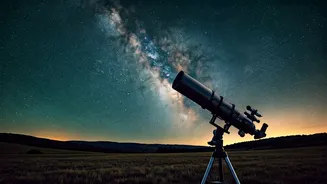
of use, portability, and the type of celestial objects the child is most eager to observe. Simpler models with straightforward controls, like those with an Alt-Azimuth mount, allow for intuitive up-and-down, left-and-right movements, which are ideal for beginners. Portability is also a significant factor; a lightweight and compact telescope can be easily set up in various locations, encouraging more frequent stargazing sessions. For instance, a telescope designed for travel can be a great companion for backyard explorations or even family camping trips. The aperture, which is the diameter of the main lens or mirror, determines how much light the telescope can gather, directly impacting the brightness and detail of the observed objects. Larger apertures generally offer brighter and more detailed views, but they also tend to make the telescope heavier and more expensive. It's about finding a balance that suits the child's age, experience level, and the desired observing targets, whether it's the moon's craters or distant planets.
Lunar Adventures Await
The Moon, Earth's closest celestial neighbor, presents a captivating and accessible target for young stargazers, offering a spectacular introduction to telescopic observation. Its surface is a tapestry of craters, mountains, and maria (dark plains formed by ancient volcanic eruptions), all of which become remarkably detailed when viewed through a suitable telescope. For lunar exploration, a telescope with a decent aperture, even as small as 70mm, can reveal stunning details. Observing the Moon during its different phases is also an enriching experience; the terminator, the line between the illuminated and dark portions of the Moon, is where the contrast is highest, showcasing the dramatic shadows cast by mountains and crater rims, creating a three-dimensional effect. Magnification plays a role, but it's not the only factor; a steady image and good light-gathering capability are paramount. Many beginner telescopes are well-equipped to provide crisp views of lunar features, allowing children to identify prominent craters like Tycho or Copernicus and appreciate the vastness of its varied terrain, fostering a sense of wonder and discovery.
Beyond the Moon
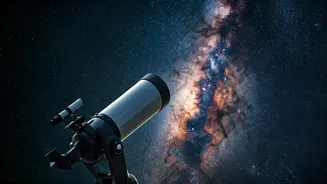
While the Moon is an immediate draw, expanding a young astronomer's view to other celestial bodies opens up a universe of possibilities. Planets like Jupiter, with its distinct bands and visible moons, offer a thrilling spectacle. Even at moderate magnifications, observers can sometimes spot the Galilean moons—Io, Europa, Ganymede, and Callisto—orbiting the giant planet. Saturn, with its majestic rings, is another prime target that often captivates young minds. While seeing the rings clearly might require a telescope with a bit more power and aperture, even a glimpse of its flattened appearance can be awe-inspiring. Mars, though smaller, can reveal polar ice caps or darker surface features during favorable oppositions. Observing these planets requires patience and looking during their optimal visibility periods. Beyond the solar system, some telescopes can also offer views of brighter star clusters and nebulae, providing a tantalizing introduction to deep-sky objects and hinting at the vastness of galaxies beyond our own cosmic neighborhood. These early experiences with planetary observation are foundational for developing a broader understanding of our place in the universe.
Smart Tech for Stargazing
The integration of smart technology has revolutionized beginner telescopes, making complex astronomical observations more accessible and engaging for younger users. Smart telescopes often come equipped with built-in databases of celestial objects and can automatically align themselves with the night sky, a process known as 'go-to' technology. This means that instead of manually searching for objects using star charts, the telescope can be commanded via a smartphone or tablet app to point directly at a chosen planet, star, or nebula. This feature significantly reduces frustration for beginners, allowing them to spend more time observing and less time on setup and manual adjustments. Some smart telescopes also offer features like built-in cameras or the ability to stream live images to a device, transforming the stargazing experience into a shared and interactive one. This technology democratizes access to the wonders of the universe, enabling children to explore the cosmos with unprecedented ease and educational depth, fostering a deeper connection with astronomy.