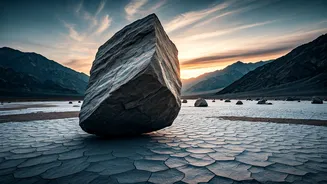








The Enigmatic Stones
The phenomenon of the sliding rocks, found in Death Valley National Park, had long puzzled scientists and nature enthusiasts. These rocks, some weighing
hundreds of pounds, mysteriously move across the flat, dried lakebed known as Racetrack Playa. The trails they leave behind record their journeys, often spanning several meters, and have sparked countless theories, from subterranean forces to extraterrestrial intervention. The lack of a clear explanation led to a decades-long pursuit to understand the specific mechanism behind this unusual natural occurrence, making it a well-known scientific puzzle, with several researchers trying to solve it. The challenge lay in observing and documenting the movements, as they were unpredictable and sporadic, making it hard to catch in action, requiring a lot of patience and innovative techniques.
Ice and Wind's Role
The key to understanding the sliding rocks lies in a rare combination of environmental conditions. Scientists discovered that the rocks move due to a particular interplay of ice and wind. During the winter, when temperatures drop below freezing, thin sheets of ice form around the rocks. As the sun rises, these sheets begin to melt, creating a slippery surface. Simultaneously, light winds can then exert enough force on the rocks, enabling them to move across the mud surface. The presence of ice is crucial, as it reduces friction. The right wind conditions are also necessary. These specific conditions explain why the rocks' movement is irregular, happening only when the elements align. It is like the perfect storm of ice and wind, making these rocks move slowly.
Detailed Investigation Process
To unravel the mystery, researchers used a range of observational and measurement techniques. They employed GPS tracking to monitor the rocks' movements, recording their paths and speeds over time. Weather stations were also installed on the Racetrack Playa, measuring wind speed, temperature, and other climatic factors. This continuous monitoring allowed them to gather data and find correlations between the rocks' movement and the prevailing environmental conditions. They also conducted experiments, deploying instruments to simulate the impact of wind and ice on model rocks. These studies affirmed the hypothesis and highlighted the specific conditions needed for rock movement. Over several years, they collected an extensive amount of data and cross-referenced it with their observations, culminating in an explanation that linked the movement of the rocks with the precise elements.
Implications and Significance
The discovery offers insights into the geological processes at work within Death Valley. It reveals how seemingly minor environmental factors can produce significant changes in the landscape. The findings also emphasize the importance of meticulous observation and interdisciplinary collaboration in scientific inquiry. This research represents a victory for scientific curiosity, showing how patient and detailed investigation can unveil the secrets of nature. The solution is also a reminder that even the most enigmatic of natural phenomena can be understood through rigorous scientific methods. The study also adds to Death Valley's reputation, attracting more visitors. The solution gives more meaning to the park.
Future Research Prospects
While the mystery of the sliding rocks has been solved, this study has opened new avenues for future investigation. Scientists may analyze the geological composition of the rocks and the lakebed sediments to study how the unique environmental conditions affect the movement. Researchers are interested in exploring how climate change impacts the frequency and intensity of these movements. They might study other similar phenomena in different environments. This ongoing research underscores the dynamic nature of scientific exploration and its ability to refine knowledge and understanding of our world. The scientific quest to fully explain the environment is always ongoing. This continuing research will improve our comprehension of geological processes and climate influences.