




Echoes of Undersea Ambition
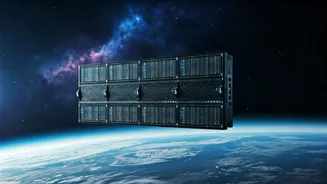
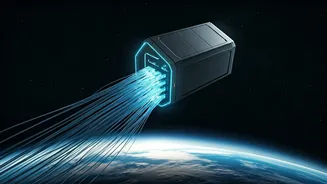
SpaceX's ambitious plan to launch a million data-center satellites into orbit, aiming to circumvent Earth's power and water limitations, bears a striking
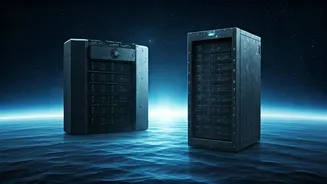
resemblance to Microsoft's "Project Natick." Initiated in 2015, Microsoft submerged a data center off the coast of Scotland, seeking to leverage natural cooling from seawater and renewable offshore energy. While Project Natick successfully met its technical objectives, demonstrating the feasibility of underwater data centers, it was ultimately abandoned over two years ago due to a lack of client interest and unfavorable economic conditions. This historical precedent serves as a crucial case study, highlighting that even technically sound innovations may falter if they don't align with market demand and financial viability. The parallels are significant: both ventures aimed to escape terrestrial constraints, utilizing self-contained, modular units, a design choice that now poses potential difficulties for SpaceX's orbital ambitions.
The Flexibility Dilemma
A key challenge that parallels Microsoft's experience and is likely to impact SpaceX's orbital data centers is the inherent inflexibility of their sealed, 'locked-for-life' designs. This design philosophy, while robust for harsh environments, presents a significant obstacle in the rapidly evolving field of artificial intelligence. AI chips are subject to yearly advancements, meaning hardware deployed in space or undersea could become outdated within a short period. Microsoft's underwater units were designed for a lifespan of five to seven years, a timeline that is increasingly insufficient given the pace of AI innovation. For SpaceX, replicating this 'locked-for-life' model in orbit means their data centers could become technologically obsolete much faster than they can be replaced or upgraded, a critical limitation for an industry that thrives on cutting-edge performance. This lack of adaptability is a major concern, as the AI industry demands constant improvement and the ability to integrate new, more powerful hardware.
Economic and Launch Hurdles
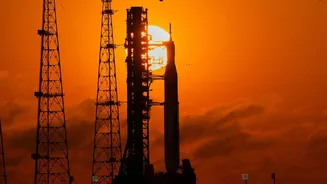
The economic feasibility of deploying data centers in space presents a far greater challenge than Microsoft faced with its undersea project. While Microsoft found underwater deployment more expensive than land-based construction, the cost of launching infrastructure into orbit is exponentially higher. Analysts estimate that SpaceX's goal of placing a million AI satellites could cost trillions of dollars, a figure that dwarfs any terrestrial or subsea endeavor. For space-based data centers to become commercially viable, launch costs per kilogram would need to plummet from thousands of dollars to mere hundreds. Although Musk plans to leverage Starship, his next-generation reusable rocket, for lower launch costs, Starship itself is behind schedule and has faced numerous setbacks in testing. This makes the economic argument for space data centers precarious, as the sheer scale of investment required is immense, and the return on investment is uncertain given the rapid obsolescence of technology and the high operational risks in space.
Harsh Space Environment
Beyond the economic and design limitations, the extreme conditions of space pose unique and formidable technical challenges for orbital data centers. Unlike the relatively controlled environment of the ocean depths, space presents a host of unforgiving factors. These include intense radiation exposure, which can degrade electronic components over time, and the lack of atmosphere, which complicates heat management. Cooling a data center in a vacuum without the possibility of using natural convection or water is a significant engineering problem. Furthermore, the harsh space environment can impact the reliability and longevity of AI chips, demanding specialized, resilient hardware. While Musk aims to overcome these issues with resilient chips and reduced launch costs, addressing radiation, heat dissipation, and the need for frequent hardware replacement in orbit presents a far more complex and costly undertaking than managing an undersea data center.
Niche Role, Not Replacement
Experts suggest that while space-based data centers may eventually have a role, it is far more likely to be a complementary one, serving specific orbital infrastructure needs rather than replacing terrestrial facilities. Companies like Blue Origin are also exploring orbital computing concepts, but the consensus among many industry analysts is that space-based data centers will remain a niche industry. They are more likely to support existing satellite constellations, space stations like the ISS (which already experiments with in-orbit data processing), and potential future space-based operations. The idea that space data centers will supplant ground-based infrastructure is considered unrealistic in the foreseeable future. Solving terrestrial challenges in energy efficiency, water recycling, and sustainable power generation on Earth is often seen as a more practical and economical path forward than venturing into the complex and expensive realm of orbital computing for general-purpose AI processing.