

Understanding Solar Flares
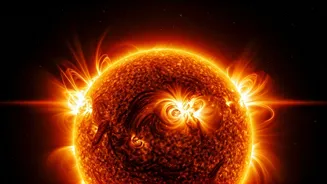
Solar flares are sudden bursts of energy that emanate from the sun's surface. These events, often associated with sunspots, release immense amounts of electromagnetic
radiation, including X-rays and visible light. The intensity of a solar flare is categorized based on its X-ray output, ranging from A (weakest) to X (strongest). Recent observations reveal that in 2022, there were several noteworthy solar flares, highlighting the sun's continued activity. These flares are capable of disrupting radio communications and, in extreme cases, can even affect power grids and satellite operations. Scientists continuously monitor solar flares to forecast their impact and protect technological infrastructure.
Coronal Mass Ejections (CMEs)
Coronal Mass Ejections (CMEs) are another type of solar event, characterized by the expulsion of large quantities of plasma and magnetic fields from the sun's corona. CMEs differ from solar flares, as they involve the release of matter, not just energy. When a CME erupts, it can travel through space and, if directed towards Earth, can cause significant effects. The interaction of a CME with Earth’s magnetic field can trigger geomagnetic storms, leading to auroras, which are beautiful displays of light in the sky. However, geomagnetic storms can also disrupt satellite operations and, in extreme cases, damage power grids. Scientists track CMEs to predict their arrival and potential effects on Earth.
Impacts on Earth
The combined effects of solar flares and CMEs can have diverse impacts on Earth. Electromagnetic radiation from solar flares can interfere with radio communications, affecting both shortwave radio and GPS signals. CMEs cause geomagnetic storms, producing auroras, also known as the Northern and Southern Lights. While the auroras are a beautiful sight, geomagnetic storms can also damage satellites in orbit, potentially leading to their malfunction or even complete failure. Severe geomagnetic storms can cause surges in power grids, potentially causing widespread blackouts. In the past, events such as the Carrington Event, a powerful solar storm, have demonstrated the potential for significant disruption. Space weather forecasting is crucial to mitigate these effects.
Recent Solar Events
Recent solar events have provided valuable insights into the sun's activity. In 2022, a notable 'solar radiation storm' occurred, triggering auroras visible as far south as Florida. Giant sunspots, like the one that sparked the Carrington Event, have recently appeared and are directed towards Earth. These events demonstrate the ongoing risk of solar flares and CMEs. Scientists have observed giant sunspots generating nearly 1,000 flares, accompanied by powerful explosions. The James Webb Space Telescope continues to help upend our understanding of black holes and the Universe. These occurrences show that solar activity can be unpredictable and can have far-reaching effects. Monitoring these events allows for improved forecasting and preparedness for potential impacts on technology and infrastructure.
Superflare Threat?
The appearance of giant sunspots and the occurrence of intense solar flares raises the question of a 'superflare threat'. A sunspot, which was comparable to the one that triggered the Carrington Event, has appeared on the sun and is facing Earth. A study revealed the sunspot shot out nearly 1,000 flares and an X-rated explosion. The potential for a powerful superflare event is a concern, as it could result in widespread disruptions. These events underscore the need to study and understand the sun's activity. Continued monitoring of solar flares and CMEs is crucial to protect essential technologies and infrastructure. Scientists continuously analyze data to assess the likelihood and potential consequences of future superflare events, allowing for informed preparedness strategies.