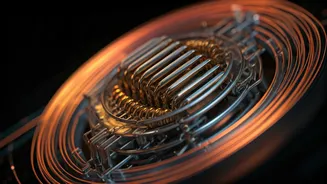







Superconducting Diodes Explained
Superconducting diodes are fascinating devices that leverage the principles of superconductivity to control the flow of electrical current. Unlike traditional
diodes, which rely on semiconductors, superconducting diodes function at extremely low temperatures, where certain materials exhibit zero electrical resistance. This unique property enables these diodes to conduct electricity without any energy loss. The key to their operation lies in the behavior of electrons within the superconducting material. When a current is applied in one direction, the electrons flow freely, but in the opposite direction, the flow is blocked. The challenge has always been to make these diodes work at higher temperatures, since the colder the environment, the more power it consumes.
Temperature Barrier Challenged
Historically, superconducting diodes have been limited by their operational temperature constraints. They typically required extremely low temperatures, near absolute zero, which presents significant practical challenges. Maintaining such conditions is energy-intensive and complex, hindering the widespread adoption of these devices. Researchers are actively working to overcome this limitation. Recent efforts have focused on identifying and experimenting with new materials, as well as refining existing techniques to improve performance at higher temperatures. Progress in this area is critical for making superconducting diodes more accessible and practical for real-world applications. The ultimate goal is to enable these devices to function at temperatures that are easier and more cost-effective to achieve, which would significantly broaden their potential uses.
Implications for Quantum Computing
The advancements in superconducting diode technology are particularly promising for quantum computing. Quantum computers, unlike classical computers, harness the principles of quantum mechanics to perform calculations. They can potentially solve complex problems that are currently intractable for conventional computers. Superconducting diodes play a crucial role in building and controlling the qubits, or quantum bits, that are the fundamental building blocks of quantum computers. These diodes are used to manage the flow of quantum information within the quantum processor. The ability to create more efficient and higher-temperature superconducting diodes can enhance the stability, scalability, and overall performance of quantum computers, paving the way for more sophisticated and powerful quantum systems.
New Paths Forward
The research into superconducting diodes opens up several new pathways for technological innovation. Beyond quantum computing, these diodes could find applications in other areas, such as high-speed electronics and sensitive detectors. The improved performance at higher temperatures could lead to more energy-efficient devices. Scientists are exploring different materials, including novel superconductors and hybrid structures, to improve the performance. The current advancements are setting the stage for future exploration. As the technology matures, it's expected to have far-reaching impacts across multiple scientific and technological domains, driving progress in fields as diverse as computing, communications, and sensing. The ongoing research represents a crucial step towards realizing the full potential of superconducting diodes and their wide-ranging benefits.