
Vampire Stars Solved
Astronomers have finally deciphered the puzzle of 'vampire stars,' celestial bodies that appear eternally young. These stars, found in the early universe,
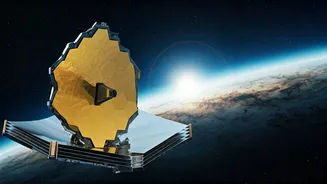
are believed to have experienced a unique form of stellar rejuvenation. The James Webb Space Telescope's advanced capabilities have allowed scientists to observe these stars with unprecedented clarity, providing crucial data to understand their prolonged youth. This discovery sheds light on the complex evolutionary processes occurring in the nascent cosmos, challenging previous models of stellar lifecycles and offering a glimpse into the dramatic conditions of the universe's infancy. The ability to witness these 'time-warped' phenomena has profound implications for our understanding of stellar evolution across cosmic epochs.
Farthest Galaxy Found
The James Webb Space Telescope has shattered its own record by identifying the most distant galaxy ever observed. This remarkable achievement pushes the boundaries of our cosmic horizon, allowing astronomers to peer further back in time than ever before. The light from this galaxy has traveled for billions of years to reach us, offering a direct window into the universe's early stages. Studying this ancient celestial object provides invaluable insights into the formation and evolution of the very first galaxies, helping scientists understand how the universe transitioned from a primordial soup of gas and dark matter into the complex structure we see today. This discovery is a testament to the telescope's extraordinary power to detect faint, ancient light.
Dark Energy's Curveball
Recent astronomical mapping has presented a significant challenge to our established understanding of dark energy. The largest-ever map of the universe reveals observations that are at odds with current cosmological models. This discrepancy suggests that our theories about the force driving the universe's accelerating expansion might be fundamentally flawed. Scientists are re-examining the nature of dark energy, considering possibilities that could drastically alter our cosmic perspective. The data implies that the universe may be behaving in ways that were previously unaccounted for, potentially necessitating a complete revision of our cosmological framework. This unexpected finding is prompting a deep dive into the most profound questions about the universe's ultimate fate and composition.
Particle Physics Breakthrough
A potential paradigm shift is brewing in particle physics with the intriguing possibility that dark matter and neutrinos might interact. For years, these elusive components of the universe have been studied in isolation, but new theoretical frameworks and observational hints suggest a deeper connection. If confirmed, this interaction could represent a 'fundamental breakthrough,' bridging two of the biggest mysteries in modern physics. Understanding such an interaction could unlock secrets about the universe's hidden mass and energy, and potentially lead to a more unified theory of fundamental forces. This area of research is at the forefront of scientific inquiry, promising to reshape our comprehension of the subatomic world and the forces that govern it.
Supermassive Black Hole
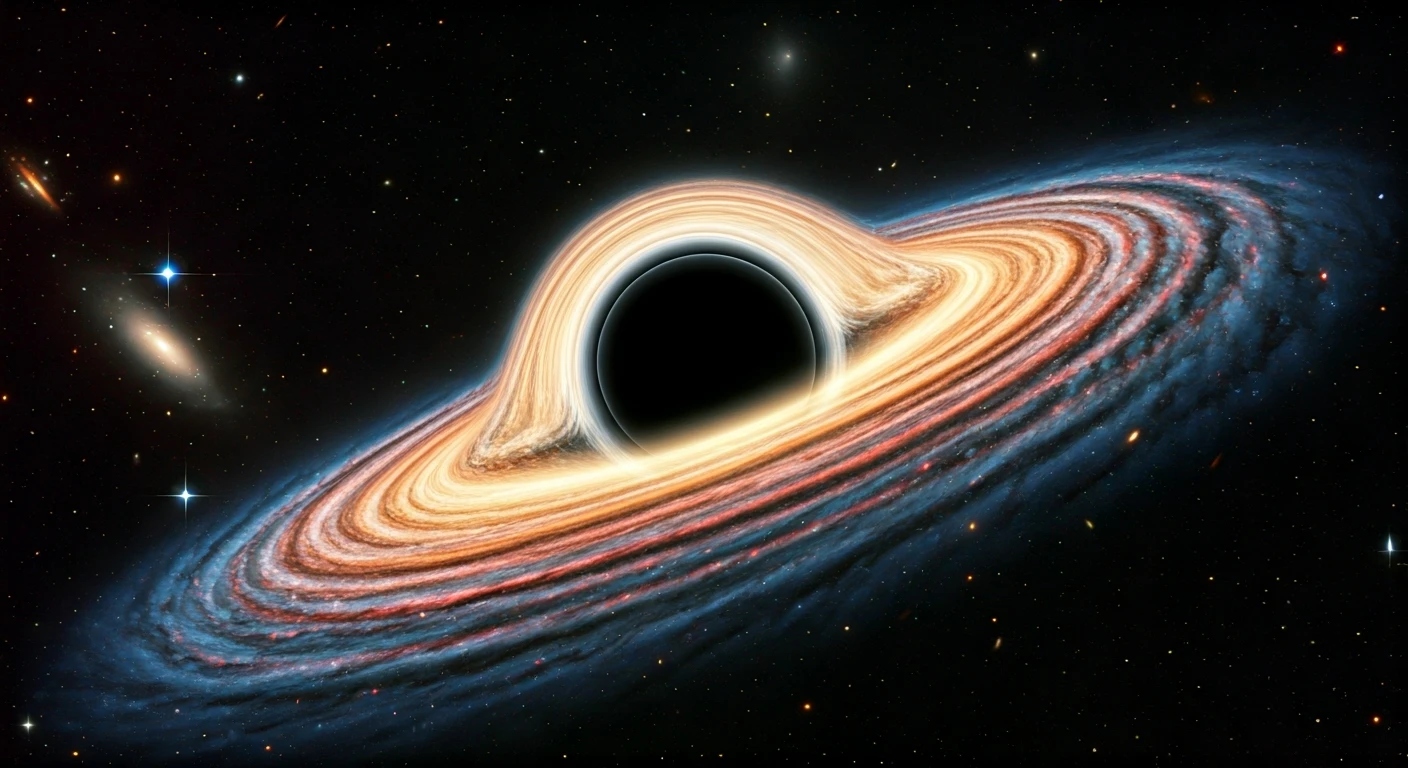
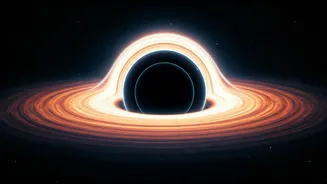
In a dramatic cosmic event, scientists have observed a supermassive black hole seemingly 'reborn' after an extended period of dormancy. For an estimated 100 million years, this colossal entity remained relatively inactive, but recent observations indicate a significant resurgence of activity. This phenomenon offers a rare opportunity to study the lifecycle and energetic processes of these galactic behemoths in real-time. Understanding how and why such black holes transition between quiescent and active states is crucial for comprehending galaxy evolution and the distribution of energy across the cosmos. The detailed study of this 'reborn' black hole could provide invaluable data for refining models of accretion and feedback mechanisms.