
Robotic Assistance Advancing
The field of robotics is experiencing a boom, with innovations that were previously only seen in sci-fi films like 'RoboCop' now becoming a reality. Robotic
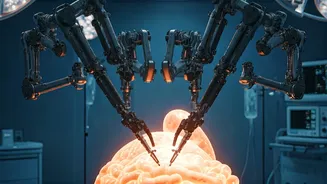
exoskeletons are being developed to help people with mobility issues. These wearable devices provide support and amplify movements, enabling individuals with paralysis or weakness to walk and perform tasks they wouldn't otherwise be able to. Furthermore, advanced surgical robots are enhancing precision in medical procedures. These robots allow surgeons to operate with greater accuracy, leading to smaller incisions, reduced recovery times, and improved patient outcomes. The future is here, with robots assisting humans in both physical tasks and complex medical interventions. These advancements are transforming everyday life and healthcare, one step at a time.
Brain-Computer Interfaces
Brain-computer interfaces (BCIs), once the stuff of futuristic movies, are making significant strides. These technologies aim to establish a direct communication pathway between the brain and external devices. Researchers are working on BCIs that enable individuals with paralysis to control computers and robotic arms with their thoughts. Imagine the possibilities for communication and restoring movement! Another exciting development involves using BCIs to treat neurological disorders. For example, BCIs can be used to deliver targeted stimulation to the brain, alleviating symptoms of conditions such as Parkinson's disease or epilepsy. As BCIs advance, they promise to revolutionize how we interact with technology and how we approach medical treatments, blurring the lines between mind and machine.
Personalized Medicine Taking Shape
Personalized medicine, where treatments are tailored to an individual's unique genetic makeup and lifestyle, is moving from the realm of theory to practical application. Advances in genetic sequencing have made it more affordable and faster to analyze a person's DNA. This information can be used to predict disease risks, diagnose conditions earlier, and select the most effective treatments. In the near future, doctors might order a genetic profile as part of a routine checkup, guiding the selection of drugs and therapies best suited for the patient. Furthermore, immunotherapy, a type of treatment that uses the body's own immune system to fight diseases like cancer, has seen remarkable progress. With immunotherapy, researchers are developing personalized cancer vaccines and cell-based therapies, offering new hope for improved outcomes. Personalized medicine is poised to transform healthcare, offering more effective, targeted, and proactive medical solutions.
3D Printing Revolutionizes Everything
3D printing, also known as additive manufacturing, is rapidly changing how we create things, and its influence is spreading into fields previously unimaginable. It's no longer just about printing plastic trinkets. 3D printing is being used to create customized medical implants, prosthetics, and even human organs. Imagine being able to print a replacement hip or a customized heart valve! In construction, 3D printing is enabling the creation of entire buildings and homes, reducing waste and construction time. The technology is also being used in aerospace and automotive industries, enabling the creation of complex parts with lighter weight and improved performance. 3D printing is a game changer, offering unprecedented design flexibility, customization, and efficiency, and its impact will continue to grow as it becomes more accessible and versatile.
Artificial Intelligence Evolving
Artificial intelligence (AI) is transforming many aspects of our lives, and its rapid development is changing the landscape of what's possible. AI is advancing across industries, from self-driving cars to medical diagnosis tools. AI-powered algorithms are helping doctors detect diseases earlier and create personalized treatment plans. In transportation, self-driving cars promise to reduce accidents and traffic congestion, paving the way for safer and more efficient travel. Natural Language Processing, a branch of AI, is enabling computers to understand and respond to human language, leading to more intuitive interfaces and better communication. AI is creating a more interconnected and automated world, which brings both opportunities and challenges as it evolves, including ethical considerations and the need for responsible development to harness its potential safely.
Advanced Energy Solutions
The quest for sustainable energy sources is driving innovation, and a few exciting advancements are nearing commercial viability. Solar energy technology is constantly improving, with more efficient solar panels and the development of new solar energy materials. Scientists are working on ways to harness the power of the sun more effectively and make it cheaper to produce electricity. Energy storage is also being revolutionized, with improvements in battery technology. Better batteries are making renewable energy sources like solar and wind more reliable by storing excess energy for later use. Fusion power, a theoretically clean energy source, is being pursued as well. While it remains a long-term project, scientists are making progress toward creating a sustainable and limitless source of energy. These developments are crucial for addressing climate change and creating a more sustainable future.
Space Exploration Advancing
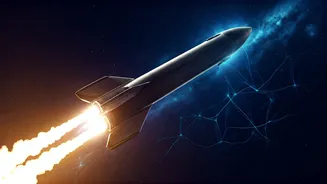
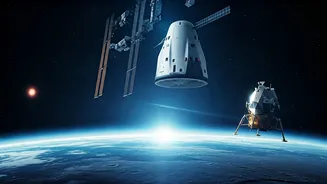
Space exploration, once the domain of governments, is now experiencing a resurgence fueled by private companies and new technologies. Reusable rockets have significantly reduced the cost of space travel, making it more accessible. Companies like SpaceX are not only launching satellites, but also developing rockets to send humans back to the moon and beyond. The discovery of exoplanets, planets orbiting other stars, has opened up the possibility of finding life beyond Earth, fueling excitement about exploration. Advances in spacecraft design and propulsion systems are making longer and faster missions possible, opening the doors to explore the solar system. This renewed interest in space has the potential to unlock new resources, scientific discoveries, and a better understanding of our place in the universe, sparking both ambition and imagination.
Virtual and Augmented Reality
Virtual reality (VR) and augmented reality (AR) are moving beyond gaming and entertainment. VR creates immersive digital experiences, while AR overlays digital information onto the real world. These technologies are finding applications in education, healthcare, and industrial design. VR is being used to create realistic simulations for training surgeons, pilots, and other professionals. AR is helping to provide real-time information and guidance, allowing workers to perform complex tasks with greater accuracy and efficiency. The metaverse, an emerging concept, is also gaining traction, offering new possibilities for social interaction, commerce, and creative expression. These technologies promise to change how we interact with information and the world around us. With ongoing advancements in displays, processing power, and user interfaces, the potential for VR and AR is immense, promising new ways of working, learning, and connecting.