







Unveiling Tree Coronae
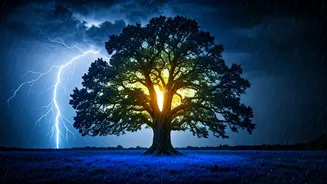
For nearly a century, scientists have theorized that trees might emit a subtle ultraviolet luminescence during thunderstorms due to electrical currents
flowing through them. This phenomenon, known as 'coronae,' was a prediction largely unverified by direct observation until recently. A pioneering study by researchers at Pennsylvania State University has achieved this crucial first: capturing direct visual evidence of these electrical discharges in natural settings. Utilizing a specially designed mobile instrument, the Corona Observing Telescope System (COTS), they were able to observe this hidden aspect of storm activity. COTS is equipped with a camera highly sensitive to a very specific band of ultraviolet light. This precise tuning was essential because the Earth's ozone layer typically filters out these particular wavelengths of sunlight, allowing the camera to detect the faint ultraviolet radiation from electrical events without being overwhelmed by ambient daylight or reflected solar radiation. This technological leap opens up entirely new avenues for understanding the complex interplay between atmospheric electricity and forest ecosystems.
Advanced Observation Tools
The successful observation of tree coronae was made possible by a sophisticated suite of scientific instruments deployed in tandem. The researchers ingeniously mounted the COTS on a research vehicle, outfitting it with a periscope. This setup provided a flexible and elevated vantage point, allowing them to track the movement of storm clouds and observe the upper reaches of tall trees from a safe distance. Complementing the visual data, an electric field mill was used to meticulously measure the intensity of the electrical charge building up within the storm. Furthermore, a comprehensive weather station diligently recorded environmental conditions such as rainfall intensity and humidity levels, providing crucial context for the observed electrical phenomena. This multi-faceted approach ensured that the recorded coronae were not only visually documented but also correlated with the precise electrical and meteorological conditions present during the event, offering a robust dataset for analysis.
Field Observations and Data
During a dramatic thunderstorm in North Carolina, the research team successfully documented the elusive coronae on both a sweetgum tree and a loblolly pine. This marked the first instance of direct, quantified evidence of these glows occurring in a natural environment. The team's findings revealed that the ultraviolet illumination was not static; rather, it exhibited a dynamic behavior, flickering and shifting sporadically from one leaf to another, and even jumping between branches. In some instances, the observed glow impressively followed the path of a branch as it swayed in the wind, demonstrating the electrical connection's fluidity. These electrical discharges were transient, typically lasting anywhere from a fraction of a second to a few seconds. By comparing these field observations with controlled laboratory experiments conducted on smaller trees, the researchers established a clear and direct correlation between the intensity of the ultraviolet glow and the magnitude of the electrical current coursing through the tree.
Quantifying the Glow
The study provided concrete figures regarding the energy and electrical current associated with these treetop coronae. The researchers determined that a typical corona discharge releases an astonishing one hundred billion photons. This light output corresponds to an electrical current of approximately one microampere (1 μA) flowing through an individual tree branch. While 1 μA might seem minuscule – about 10,000 times less current than what powers an LED – the significance lies in the sheer scale of these events. The researchers noted that as the storm passed overhead, these discharges occurred across entire forest canopies simultaneously. When summed up, this widespread phenomenon translates into a substantial collective electrical current flowing through the forest. Further observations across four additional storms in diverse locations, from Florida to Pennsylvania, suggest that these captivating 'swaths of scintillating corona glow' are a common and widespread occurrence during periods of intense thunderstorm activity.
Atmospheric Implications
The implications of these findings extend significantly to our understanding of atmospheric processes. The researchers highlight that the coronae generated by glowing trees produce substantial amounts of hydroxyl radicals (OH–). These radicals act as a natural 'detergent' for the atmosphere, playing a crucial role in removing hydrocarbons and thereby influencing the overall air quality within forests. Beyond chemical reactions, the intense voltage surges associated with these glows can inflict minor but permanent damage to trees, often manifesting as a slight scorching on the fine tips of leaves. Moreover, the collective electrical charge released by millions of illuminated trees could potentially influence the very electrification of the storm clouds situated directly above them, suggesting a feedback loop between the forest and the atmosphere.