






Supermoon's Lunar Display
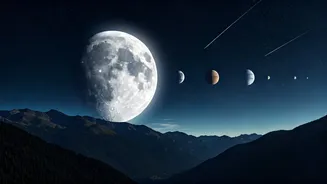
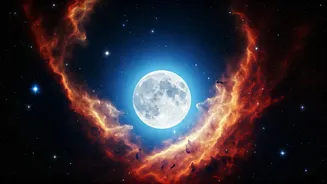
The year 2026 will present a captivating celestial spectacle with the Wolf Moon Supermoon rising in January. This rare event, occurring near the moon's
perihelion, will illuminate the night sky, creating a breathtaking display. The supermoon, appearing larger and brighter than usual, will offer an excellent opportunity for skywatchers to observe the lunar surface and appreciate the beauty of our celestial neighbor. Accompanying the moon will be Jupiter, adding to the visual appeal of this extraordinary astronomical alignment. The occurrence highlights the dynamic interplay of celestial bodies and the unique events that unfold in the vast expanse of space.
Young Star's Strange Behavior
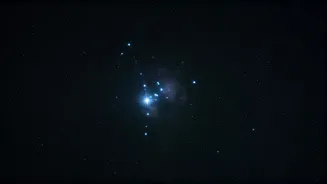
Astronomers are actively studying a young star located 1,950 light-years away, trying to understand its unusual behavior. By analyzing data collected from advanced telescopes, they are attempting to decode the star's characteristics and unravel the causes behind its irregular patterns. This study contributes to our understanding of stellar evolution, as it offers insights into the formative stages of stars. The findings from this research could shed light on broader processes of star formation and provide a deeper understanding of the universe's evolution. Exploring such distant phenomena assists scientists in connecting the dots and constructing a more comprehensive model of the cosmos.
Star Birth in Cloud
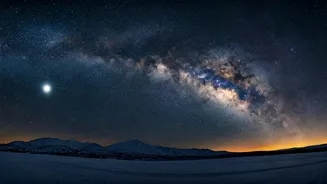
The Large Magellanic Cloud (LMC), a satellite galaxy of the Milky Way, has become a focus for astronomers studying the birth of stars. They are examining this vast stellar nursery to understand how stars come into existence and develop. The LMC offers a unique perspective due to its proximity and structure, allowing for more detailed observations. By studying the formation processes within the LMC, astronomers can gain insights applicable to star formation throughout the universe. Such explorations contribute significantly to the ongoing efforts to map and comprehend the cosmic environment, and to understand how these processes influence galaxies and star systems, including our own.
Tracing Dark Matter
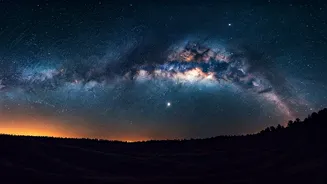
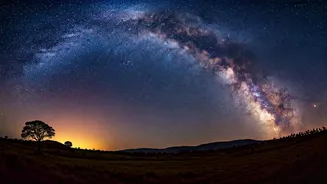
Utilizing runaway stars, scientists are tracing the distribution of dark matter within the Milky Way. These fast-moving stars, ejected from their original locations, provide a unique probe into the invisible substance. By tracking their trajectories, researchers are reconstructing the distribution patterns of dark matter, offering critical information about its influence on galactic structure. Dark matter, a mysterious component of the universe, makes up a substantial portion of its total mass. Understanding its distribution is vital to understanding galaxy formation and evolution. The insights gained from tracking these stars are assisting in constructing a more comprehensive model of our galaxy and its mysterious constituent dark matter.