






Mission Introduction
The PSLV-C62 mission, undertaken by the Indian Space Research Organisation (ISRO), stands as a notable step forward in India's space program. Missions
like this highlight India's advancements in space technology, which contributes to scientific research and national development. This mission often involves the launch of satellites designed for various purposes, including Earth observation, communication, and scientific experimentation. The PSLV, or Polar Satellite Launch Vehicle, has become a reliable workhorse for ISRO, carrying payloads into different orbits. Each mission builds on previous successes, pushing the boundaries of what is possible in space exploration and technology. Overall, the PSLV-C62 mission demonstrates India’s growing capabilities in space.
Mission Objectives
The primary objectives of the PSLV-C62 mission generally encompass a variety of scientific and technological goals. A core focus typically involves deploying one or more satellites into a designated orbit. These satellites might serve Earth observation purposes, offering crucial data for environmental monitoring, resource management, and disaster assessment. Also, they could be designed for communication, providing vital links for data transmission and information exchange across vast distances. Furthermore, scientific payloads on board may facilitate experiments in the space environment, exploring areas like astrophysics, materials science, or the study of the Earth’s atmosphere. Each objective is carefully planned to ensure the mission's overall success and contribute to the growth of space-based knowledge and capabilities.
Technical Aspects
The PSLV-C62 mission incorporates cutting-edge technical aspects, beginning with the launch vehicle itself. The PSLV is a multi-stage rocket, designed to transport satellites into various orbits with precision. It usually consists of solid and liquid stages, providing the necessary thrust for liftoff and orbital insertion. The selection of the launch site is critical, considering factors such as safety, geographic location, and access to desired orbital parameters. The payload, which contains the satellites and associated instruments, is carefully integrated into the launch vehicle, ensuring structural integrity and functionality throughout the mission. Propulsion systems are essential for maneuvering the rocket and satellites in space. Advanced onboard computers and guidance systems manage the complex flight path, providing accurate placement of the satellites in their designated orbits, which are critical for the missions’ success.
Satellite Payload
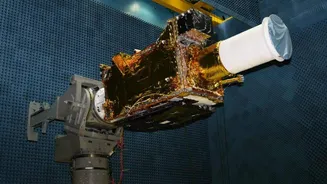
The satellite payload carried by the PSLV-C62 mission typically consists of one or multiple satellites, each engineered for specific purposes. The type of satellite will influence the mission's trajectory, the orbit it takes around the Earth. Earth observation satellites, for instance, are equipped with sophisticated instruments like high-resolution cameras, multispectral scanners, and radar systems. These tools offer detailed imagery and data on various environmental aspects, including land use, deforestation, and climate patterns. Communication satellites are also an essential component. They usually include transponders and antennas, enabling them to relay signals across vast distances for communication networks, providing crucial infrastructure for global connectivity. Scientific payloads on board may incorporate sensors and experiments to study phenomena like cosmic rays or the Earth’s magnetic field. Together, the satellite payload forms the core of the PSLV-C62 mission.
Mission Significance
The PSLV-C62 mission holds substantial significance for India’s space program and its broader scientific community. It marks another success in ISRO’s ongoing efforts to advance its space capabilities, enhancing India’s standing on the world stage. Space missions like these stimulate innovation, pushing the boundaries of engineering and technological research. The collected data is crucial, driving scientific discovery. The mission's success contributes to educational initiatives by offering hands-on learning. The project also plays a pivotal role in national development, supporting various sectors like agriculture, disaster management, and telecommunications. In essence, the PSLV-C62 mission represents India’s continued dedication to space exploration and its potential for transforming life on Earth.