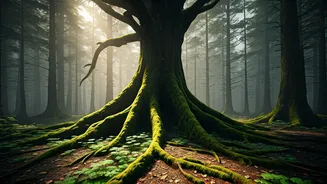








Roots of Connection
The author, a forest ecologist, found herself grappling with her mother's declining health due to Alzheimer's. Simultaneously, she was actively protesting
the destruction of old-growth forests. This dual experience highlighted the interconnectedness of life, from the matriarchal trees in her research to the human matriarch in her family. Her decades of studying how trees communicate and support each other through intricate underground fungal networks, where 'mother trees' act as vital hubs, provided a profound lens through which to view her own life and impending loss. The resilience and wisdom held within these ancient trees, passing down genetic legacies and nurturing new growth, began to resonate deeply with her understanding of life's inevitable transitions and the continuity of existence.
Nature's Grand Design
Suzanne Simard's groundbreaking research revealed that the largest, oldest trees, often termed 'mother trees,' are central to forest ecosystems. These giants act as crucial nodes in a subterranean network of mycorrhizal fungi, which form symbiotic partnerships with tree roots. Through this network, trees exchange essential nutrients that fungi gather from the soil for the carbon produced by trees during photosynthesis. This vast underground web facilitates the transfer of carbon, water, and nutrients across the forest, connecting established trees with young seedlings. Her findings demonstrated that these mother trees actively contribute to forest regeneration by providing genetic material for future generations, offering shelter to vulnerable saplings, and sustaining aquatic ecosystems. The wisdom encoded in their genes represents a legacy of past climates, invaluable for navigating current environmental challenges. As these ancient trees eventually age and decline, they contribute to the food web, creating the conditions for new seedlings to thrive and mature into the next generation of elder trees, perpetuating a cycle of endurance and adaptability.
Echoes of Resilience
Following her mother's passing, the author sought solace and perspective in the wild. A hike with her daughter through a landscape recently scarred by wildfire offered a powerful visual metaphor for life's enduring cycles. Despite the evident destruction, vibrant new growth—fireweed and pearly everlasting—was already emerging from the scorched earth. This observation reinforced her understanding of nature's innate capacity for healing and renewal. She recognized that even after significant disruption, ecosystems possess an inherent ability to re-establish themselves, forming new, resilient communities adapted to changing environments. This process, deeply integrated with generational interactions and feedback loops among plants, fungi, and animals, underscored the idea that death is not an end but a catalyst for creation. The breakdown of fallen logs by decomposers, the transformation of organic matter into life-sustaining soil, and the passing of genetic knowledge from elder to younger trees all spoke to a continuous, regenerative flow—a cycle to which she could also aspire to return.
Cycles of Existence
The author found profound comfort in viewing life, and indeed her mother's existence, through the lens of cyclical, rather than linear, progression. Just as forests undergo constant cycles of birth, growth, decay, and rebirth, so too do living beings. The energy and wisdom of older generations are consistently passed on to younger ones, a continuous flow of existence. Her mother, having reached her 'release stage,' was passing on her final wisdom, a natural culmination of her life's journey. Imagining her mother's spirit merging into an infinite cycle of life, connected to the energy of ancestors and the ongoing flow of life, provided a sense of peace. This perspective mirrored the forest's own regenerative processes, where new life emerges from and reorganizes around the legacies left behind, demonstrating that even in loss, transformation and recovery are inevitable.