






Distant Cosmic Flash
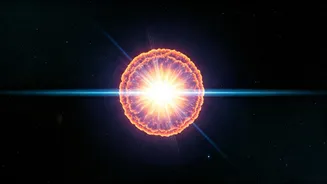
Approximately 8 billion light-years away, a remarkable event occurred, leaving astronomers both intrigued and perplexed. This observation involved a transient
cosmic explosion, a phenomenon which lasted an unexpectedly short seven hours. This brief yet potent burst of energy occurred at such a distance, making the event even more remarkable. The very fact that this event was detected is significant, as it suggests the explosion was unusually intense, enabling its detection across such an immense cosmic gulf. This discovery prompts investigation into the origin and nature of the energy released, challenging existing models of astronomical occurrences.
Observing the Event
The ability to observe such a distant and fleeting event required specialized astronomical equipment. High-powered telescopes and sensitive detectors were essential for capturing the brief burst of energy. Because of its distance, the event’s light, which traveled for billions of years, reached Earth as faint signals. The instruments used were capable of identifying the subtle changes in light and other emissions, allowing scientists to pinpoint the event and gather data about its characteristics. Telescopes and detectors played a vital role in analyzing the properties of the explosion, including the energy levels, the spectral signatures, and the duration, all of which provided valuable insights into the nature of the cosmic event.
Duration and Intensity
The remarkably short duration of seven hours is one of the most intriguing aspects of this cosmic explosion. In comparison to other astronomical events, such as supernovae that can last for weeks or months, this event was exceptionally brief. The intensity of the explosion, given its short lifespan, implies a powerful release of energy within a limited time. Its brightness, despite the immense distance, underscores the concentration of energy. The observed intensity during this brief period is a focal point of scientific investigation, encouraging deeper examination of the mechanisms that could facilitate such a rapid and potent energy burst. This aspect contributes to the challenge in understanding the event within existing cosmological models.
Possible Explanations
Understanding the nature of the cosmic explosion requires scientists to consider a range of potential causes. Although the cause remains undetermined, several possibilities are being explored. One hypothesis considers the potential for unusual interactions involving compact objects such as neutron stars or black holes. Another theory points to the possibility of a novel type of stellar event, or a yet-unidentified phenomenon. Additionally, researchers are analyzing the spectral data for indicators of the elements present. By studying these elements, astronomers can learn more about the nature of the explosion. These investigations, in addition to future observations, may provide critical evidence that sheds light on the nature of this remarkable cosmic event.
Future Research
Further research is essential to fully understand this unusual cosmic explosion. Researchers intend to continue analyzing the data and comparing it with models. The next step will include observations using other telescopes and instruments across various wavelengths to obtain a more complete picture of the event. Furthermore, scientists plan to develop new simulations to explore the various scenarios that could produce this type of short-lived, high-energy event. The ongoing study will also involve collaboration among scientists from various institutions to exchange data, findings, and knowledge. These concerted efforts are crucial to deepen understanding and to unravel the mysteries of this intriguing cosmic flash.