
What Exactly Are?
Black holes are regions in spacetime with gravitational forces so intense that nothing, not even light, can escape their grasp. They form when massive
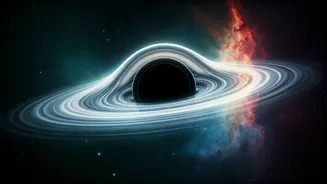
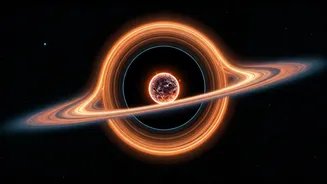
stars collapse at the end of their life cycle or through the merger of smaller black holes. The point of no return, known as the event horizon, marks the boundary beyond which escape is impossible. Once matter crosses this threshold, it is inexorably drawn towards the singularity at the center – a point of infinite density. Scientists can observe black holes through their effects on surrounding matter, such as the swirling accretion disks of superheated gas that emit powerful X-rays, or through gravitational lensing, where the gravity of the black hole bends and distorts light from background objects. The study of black holes provides insights into extreme physics, the behavior of matter under intense gravity, and the evolution of the universe.
Formation of Black Holes
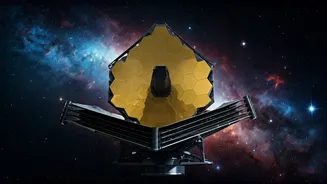
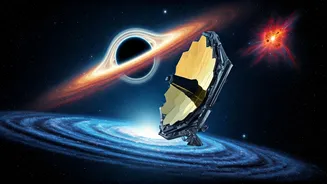
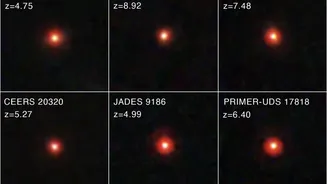
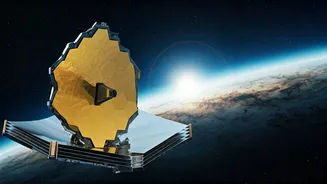
Black holes originate primarily from the collapse of massive stars. When a star exhausts its nuclear fuel, it can no longer generate the outward pressure needed to counteract gravity, leading to its core collapsing inward. If the star is sufficiently massive, this collapse continues until a singularity is formed. Another way black holes form is through the mergers of existing black holes. These mergers produce gravitational waves, which can be detected by observatories like LIGO and Virgo, providing valuable information about the properties and behavior of black holes. The James Webb Space Telescope has also played a crucial role in observing the early universe, detecting what may be the earliest and most distant black holes, giving insights into how these objects formed shortly after the Big Bang. These discoveries help us understand how these celestial powerhouses came to exist.
Falling into One
The experience of falling into a black hole would be nothing short of bizarre and terrifying, though it is purely hypothetical for any observer. As an object approaches the event horizon, the effects of strong gravity become increasingly apparent. From the perspective of an outside observer, the infalling object would appear to slow down and fade, never quite reaching the event horizon. However, for the object itself, the experience would be dramatic. Tidal forces would become extreme, stretching the object vertically and compressing it horizontally – a process humorously called spaghettification. The intense gravity would also cause severe time dilation, with time slowing down dramatically for the infalling object compared to an outside observer. Eventually, the object would be crushed into the singularity. These concepts help scientists understand the extremes of gravity and the behavior of matter at these extreme conditions.
Black Holes Observed
Despite their darkness, black holes are not entirely invisible. Scientists use a variety of methods to 'see' them. One method is to observe the behavior of matter around them. When gas and dust fall into a black hole, they form an accretion disk, which heats up to incredibly high temperatures and emits X-rays. Astronomers can detect these X-rays, which helps them identify the presence of a black hole. Another method uses gravitational lensing, where the immense gravity of a black hole bends and distorts the light from objects behind it, creating a visible distortion. The James Webb Space Telescope and other advanced instruments are now capable of observing jets of particles being ejected from black holes, providing more details. In 2023, scientists detected the gravitational waves from a black hole collision that seemed impossible. The advanced technology provides new perspectives on black holes.
Black Hole Mergers
Black hole mergers are among the most energetic events in the universe, and the detection of gravitational waves from these events has revolutionized our understanding. When two black holes collide, they spiral closer together and eventually merge, creating a new, more massive black hole. This process releases a tremendous amount of energy in the form of gravitational waves, which travel through spacetime at the speed of light. The detection of these waves by observatories such as LIGO and Virgo has allowed scientists to study the properties of black holes and test Einstein's theory of general relativity in extreme conditions. Recent research has also provided evidence that rare 'second-generation' black holes were involved in mergers. The information provides crucial insights into how black holes grow and interact with their environment, including the nature of dark matter and the evolution of galaxies.