



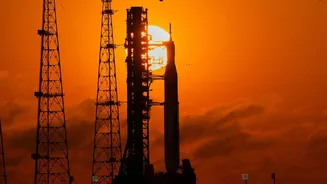

Propulsion and Vessel
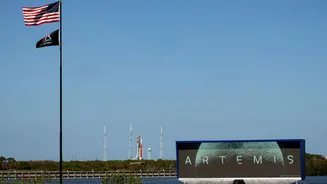
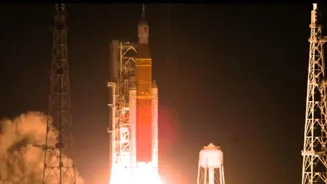
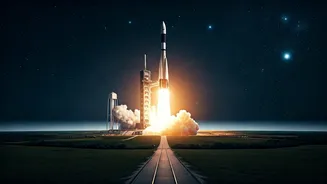
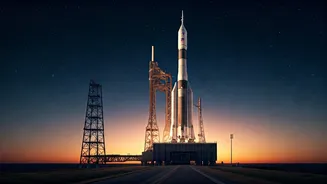
Artemis II is poised to ascend on the might of NASA's Space Launch System (SLS) rocket, a colossal engineering marvel that dwarfs the Statue of Liberty
in its fully assembled form. This powerhouse launch vehicle is engineered to propel the Orion spacecraft, carrying its precious human cargo, on its lunar expedition. The Orion itself, a sophisticated vessel approximately five meters in diameter, is the product of a collaboration between NASA and Lockheed Martin. Its design prioritizes deep-space survivability, featuring advanced life support systems to sustain the astronauts, a formidable heat shield designed to endure re-entry speeds approaching 30 times the speed of sound, and robust solar arrays that provide essential power throughout the mission. This intricate pairing of the SLS and Orion represents a significant leap in our capability to send humans beyond Earth's orbit.
The Astronaut Quartet
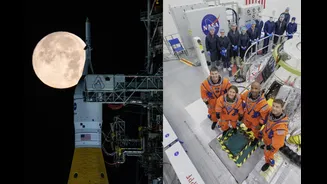
The Artemis II crew is a carefully curated ensemble of four highly experienced individuals, each bringing a wealth of expertise from previous space endeavors. Leading the mission as commander is NASA astronaut Reid Wiseman, whose prior experience includes a significant stint aboard the International Space Station (ISS) during Expedition 41. Piloting the Orion will be Victor Glover, who has a proven track record from the Crew-1 mission to the ISS aboard a SpaceX Crew Dragon. Mission specialist duties fall to Christina Koch, an astronaut holding the remarkable record for the longest single spaceflight by a woman, having spent 328 days on the ISS. Rounding out this pioneering team is Jeremy Hansen from the Canadian Space Agency, also serving as a mission specialist. Together, this crew will achieve the distinction of being the first humans to venture beyond low Earth orbit since the historic Apollo missions concluded.
Lunar Trajectory Details
The Artemis II mission will follow a meticulously planned free-return trajectory, a clever utilization of lunar gravity to guide the Orion spacecraft back to Earth. This ingenious path minimizes the need for extensive onboard propulsion for the return journey. Following its launch, Orion will separate from the SLS and execute several orbits around Earth to rigorously test its critical systems before embarking on its lunar course. The transit to the Moon is expected to take approximately four days. A pivotal moment of the mission will occur when the spacecraft passes behind the far side of the Moon, coming to within an estimated 6,000 miles of the lunar surface at its closest point. This unique vantage point will offer the crew an unparalleled opportunity to observe and capture images of the Moon's unexplored far side. The entire mission is slated to last around 10 days, culminating in a planned splashdown in the Pacific Ocean.
Mission's Core Objective
The paramount objective of Artemis II is not a lunar landing, but rather a comprehensive crewed test flight designed to validate the operational readiness of the Orion spacecraft and its integrated systems in the challenging environment of deep space. Key to this mission is the meticulous verification of Orion's life support systems, its thermal control mechanisms, its communication links, and its navigation capabilities with humans aboard. The astronauts will undertake a series of vital checkouts and performance demonstrations. This includes engaging in proximity operations, which simulate the critical maneuvers required for future docking with other spacecraft, even though no actual docking will take place. Furthermore, the crew will diligently collect valuable data pertaining to radiation exposure and other environmental conditions encountered far from Earth. The engineering insights gleaned from this mission will be instrumental in refining procedures for subsequent Artemis missions, including Artemis III, which aims for a lunar landing. While the crew won't set foot on the Moon, their detailed observations and photographic documentation of the lunar far side will contribute significantly to our ongoing scientific understanding of the Moon's geological evolution.
Global Partnership and Payloads
Artemis II stands as a testament to international cooperation in space exploration, bringing together a coalition of global space agencies. Key partners include the European Space Agency (ESA), the Canadian Space Agency (CSA), and the Japan Aerospace Exploration Agency (JAXA), each contributing vital expertise and resources. Beyond these major partners, space agencies from Germany, South Korea, Saudi Arabia, and Argentina will also participate by flying CubeSats aboard the spacecraft. These miniature satellites are scheduled for deployment in high Earth orbit, offering unique opportunities for scientific research. Additionally, the German Aerospace Centre will leverage the Artemis II mission to conduct critical research focused on radiation within the space environment. This collaborative effort underscores the shared ambition to push the boundaries of human spaceflight and scientific discovery.