






Market Misunderstanding
Recent market jitters, fueled by advancements like Anthropic's Claude Cowork, have led investors to speculate about AI's potential to supplant traditional
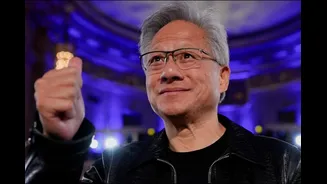
software companies, impacting major players in the industry. However, Nvidia CEO Jensen Huang has publicly stated that this widespread fear is misplaced, arguing that the market has misinterpreted the true impact of artificial intelligence. Huang believes that AI's integration into the professional landscape will not result in the obsolescence of established software tools but rather in a symbiotic relationship where AI acts as an advanced intermediary. He challenges the notion that AI will directly replace the functionalities currently provided by software giants, suggesting a more nuanced evolutionary path for technology adoption.
AI Agents as Tool Users
Huang's core argument centers on the concept of AI agents as sophisticated 'tool users.' He elaborates that instead of humans directly interacting with AI to then use software, it will be AI agents themselves that operate these legacy applications on our behalf. This means that established software platforms, such as SAP or ServiceNow, which are fundamental to numerous business processes, will persist because they serve a crucial and enduring purpose. AI, in this paradigm, becomes an intelligent layer that leverages these existing tools, acting as a digital assistant to amplify human efficiency and output. The AI will not reinvent the wheel but will become adept at operating the established machinery of business software.
Enhancing Productivity Through Tools
The Nvidia CEO emphasizes that the efficiency and robustness of current software tools are the result of years of development and industry-specific refinement, making them highly optimized for their respective tasks. He posits that AI will not surpass these tools in their core functions but will instead harness their power to accomplish objectives. The ultimate goal, Huang explains, is for these AI agents to utilize the existing software to complete complex tasks, consolidate information, and then present it back to humans in an easily digestible format. This approach ensures that the specialized capabilities of legacy software remain valuable while benefiting from the advanced processing and automation capabilities that AI offers, leading to a significant boost in overall productivity.
Nvidia's Growth and AI
Huang's pronouncements regarding AI's role align with Nvidia's significant business trajectory. The company, a key provider of the GPUs powering AI data centers, recently reported a substantial 73 percent surge in revenue for the fourth quarter of FY25, reaching $68.13 billion compared to the previous year. The annual revenue figure stood impressively at $215.9 billion. Huang attributed this growth to customers' vigorous investment in AI compute infrastructure, referring to these as 'factories powering the AI industrial revolution.' Looking ahead, Nvidia anticipates an even stronger first quarter of FY26, projecting revenue of $78 billion. This robust performance solidifies Nvidia's position as the world's most valuable publicly-traded company, with a market capitalization of $4.8 trillion.