
Unveiling Cosmic Secrets
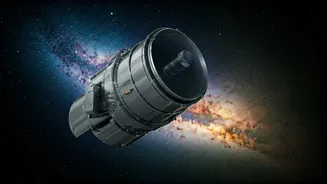
The SPHEREx mission, a significant project of NASA, is a step towards understanding the universe's early history and how galaxies have evolved. Utilizing
infrared light, SPHEREx is currently working on creating a comprehensive 3D map of the sky. This map will enable scientists to study the universe's infancy, including the period after the Big Bang and the subsequent development of galaxies. By analyzing the infrared light, the project is able to discern the composition and distribution of celestial objects, which provides insights into their formation and development. This innovative approach offers scientists a unique tool to research cosmic origins and the evolution of galactic structures.
Mapping the Cosmos
SPHEREx's primary objective is to produce a detailed map of the entire sky using infrared light. This comprehensive mapping effort is essential for identifying the building blocks of the universe and tracing how galaxies came to be. The telescope's capability to see the infrared spectrum allows it to detect objects that are hidden from the view of visible light telescopes. With this advanced view, researchers can study areas obscured by dust and gas, thereby gaining information about the composition and temperature of these regions. The resulting 3D map will give an unprecedented view of the distribution of galaxies and the history of their formation, thereby facilitating a better understanding of the universe's evolution.
Mission's Scientific Goals
The SPHEREx mission is designed with several crucial scientific objectives in mind. One of the primary goals is to study the origin and evolution of galaxies, which includes how they were formed and how they have changed over time. By looking at the light emitted by galaxies in the early universe, SPHEREx provides insights into their composition and the processes that drove their development. Additionally, the mission will search for the sources of inflation, the rapid expansion of the universe following the Big Bang, and investigate the early universe. Another key goal is to understand how the elements in the universe, which were created in the stars, were distributed over cosmic time. These scientific objectives will allow researchers to test some of the most fundamental theories in cosmology and astrophysics.
Infrared Light's Importance
Infrared light is an indispensable tool for SPHEREx because it enables the telescope to see through clouds of dust and gas that obstruct visible light. The universe is filled with such areas, making infrared observations critical for understanding what is hidden from standard telescopes. Infrared light can penetrate these obstructions, allowing scientists to study the composition and physical properties of objects that would otherwise be invisible. By analyzing the light, researchers can identify the chemical makeup of objects and examine the temperature variations throughout space. This capability is especially important for studying the early universe, where dust and gas clouds were more abundant, and understanding the processes of star formation and galaxy evolution.
Expected Discoveries Ahead
The SPHEREx mission is expected to deliver a wealth of exciting discoveries that will significantly impact our comprehension of the universe. The 3D map created by the telescope will allow scientists to study the distribution of galaxies on a large scale. This will provide new details about their formation and evolution over billions of years. By analyzing the data, scientists expect to better understand the processes of inflation, the initial rapid expansion of the universe, and will gain insight into the distribution of dark matter and dark energy, which are major components of the universe. These observations will greatly improve our understanding of the universe's composition, structure, and history, therefore deepening our knowledge of cosmic origins.