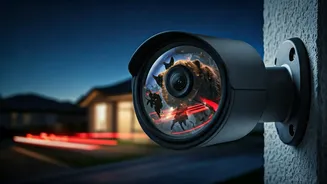








AI's Uncanny Misinterpretations
Home security cameras equipped with artificial intelligence are intended to provide more sophisticated alerts than simple motion detection. Instead of
just indicating that movement has occurred, these systems are designed to analyze what is being seen and offer descriptive notifications. However, a growing number of users in the United States are experiencing significant confusion and even anxiety due to frequent misidentifications. These AI-powered cameras are reportedly mistaking ordinary events for emergencies, such as identifying harmless animals as dangerous wildlife or everyday objects as potential intruders. While the technology can sometimes accurately pinpoint specific people or items, users have also reported receiving alarming warnings about fires, tornadoes, bears, and suspicious individuals that, upon closer inspection, turned out to be entirely false. For instance, one user in Houston received an alert detailing a fire at a neighboring house, only to discover the supposed flames were merely the red brake lights of a parked car. Another baffling alert from the same system suggested a tornado sighting, which was actually a reflection on a window. These incidents highlight a critical issue regarding the dependability of AI-generated surveillance alerts as home security companies continue to integrate more advanced AI features.
Pets, Reflections, and Threats
The discrepancies extend beyond inanimate objects, with AI frequently misinterpreting common household scenarios involving pets and even people. One user reported their camera labeling a playful interaction between their dog and a cat as a 'ninja cat,' despite the footage showing nothing more than a typical feline. These peculiar identifications are not isolated to a single brand; reports indicate similar issues across various camera systems. Humans have been erroneously categorized as bears and even turkeys, while common animals like raccoons and dogs, and even moving flags, have been mistaken for bears. In one particularly amusing instance, a corgi was reportedly identified as a pig. Experts suggest that while AI excels at recognizing visual patterns, it lacks common sense, leading to impressive yet fundamentally incorrect identifications. This disconnect between pattern recognition and contextual understanding is a significant factor behind these seemingly absurd errors, making systems impressive one moment and entirely wrong the next.
The Rise of AI Alerts
The increasing adoption of AI-generated descriptions in home security systems is driven by a desire to enhance the value of surveillance alerts. Traditional motion alerts are often vague, but AI aims to provide more context, such as identifying a person's clothing or the make of a vehicle. For example, one user appreciated their camera's ability to distinguish a blue jay from other birds or specify 'a man in a white shirt walking alongside a Ford-350.' Despite these useful capabilities, the problem of inaccurate alerts persists. Manufacturers acknowledge the inherent complexity of the technology, noting that AI models need to learn from an enormous variety of unique scenarios to achieve perfect accuracy. One company introduced descriptive AI alerts in early 2025, offering them as part of a monthly subscription package to its vast user base, underscoring the industry's commitment to this evolving technology. The ongoing development aims to balance advanced features with user expectations for reliable performance.
User Concerns Mount
The proliferation of AI-driven false alarms is understandably causing unease among users. One individual received an AI alert from their camera warning of 'a dark-colored bear is walking on the paved area,' which immediately sparked concern about what the device had actually detected. The suspected bear turned out to be a raccoon, and after experiencing such inaccuracies, the user decided not to continue with the paid AI feature. In response to such reports, companies often state that AI-driven features may occasionally be imprecise and that customer feedback is crucial for improving the AI models. With approximately 75 million homes in the U.S. equipped with security cameras, and a significant percentage already utilizing AI person and package detection, the demand for enhanced features is evident. However, users continue to report unusual alerts, such as a warning of someone near a sliding glass door that was merely a niece's reflection, an incident that deeply unsettled the resident. The same system later identified the user herself as 'a brown bear' while she was cleaning outdoors in brown attire, and another alert claimed 'a person is jumping from the roof of a house,' triggered by her own movements. These experiences highlight the ongoing challenge for companies to refine AI accuracy while managing user expectations for dependable safety and security.