
Einstein's Groundbreaking Theory
Albert Einstein's theory of general relativity, proposed over a century ago, transformed our understanding of gravity. It explained gravity not as a force,
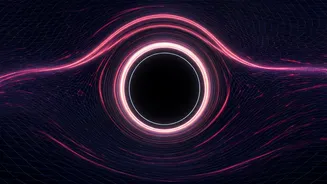
but as a curvature in the fabric of spacetime caused by mass and energy. The theory predicted that massive objects, like black holes, would warp spacetime significantly. This warping effect would influence the paths of objects moving nearby, like light, causing it to bend. Despite its theoretical elegance, directly observing the effects of spacetime distortion near a black hole proved incredibly challenging. The recent observation, therefore, stands as a crucial validation of Einstein's century-old predictions.
Observational Breakthrough Unveiled
Astronomers achieved this milestone using advanced observational techniques. They focused their attention on a region surrounding a black hole. Their observations revealed the black hole's influence on the surrounding environment. The black hole's immense gravity caused a noticeable twist in the spacetime around it. This twisting effect was detected through the behavior of light emitted from the area surrounding the black hole. The study meticulously tracked the movements of gas and other matter swirling around the black hole. These observations provided empirical evidence that directly validated the effects of spacetime distortion predicted by Einstein's theory. This observation is considered a remarkable achievement in astrophysics.
Implications for Astrophysics
The confirmation of spacetime twisting has far-reaching implications for astrophysics. It bolsters our confidence in the accuracy of Einstein's theory, providing a robust framework for understanding the behavior of objects in extreme gravitational environments. Furthermore, this observation provides valuable insights into the properties of black holes. The data gathered helps scientists better understand the structure of these objects. It also aids in understanding the dynamics of matter in their vicinity. With a deeper understanding of black holes, researchers can push forward in investigating the evolution of galaxies and the large-scale structure of the universe.
Future Research Directions
This discovery marks a significant leap in our ability to probe the fundamental nature of the universe. Scientists are already planning the next steps to build upon this breakthrough. They plan to use even more advanced telescopes and observational techniques. Researchers aim to study a wider range of black holes. They hope to learn more about the universe's past and future. These projects might provide further evidence of gravitational waves, a phenomenon associated with massive cosmic events. The focus is also on improving theoretical models of black holes, incorporating the new data to build a more comprehensive understanding of their influence on the cosmos. These future explorations hold the potential for even more profound revelations.