







A Prestigious Global Honor
The Chhari-Dhandh Wetland Conservation Reserve, nestled within Gujarat's Kachchh district, has officially been recognized as a Ramsar Site, denoting its
status as a Wetland of International Importance. This significant designation, achieved on January 31, 2026, thrusts this vital ecological area onto the global stage and underscores India's commitment to wetland preservation. The certificate was formally presented to Chief Minister Bhupendra Patel by Gujarat's Forest and Environment Minister Arjun Modhwadia. This achievement marks Chhari-Dhandh as Gujarat's fifth Ramsar Site and a pioneering inclusion from the Kachchh region, highlighting its distinctive ecological value and the successful culmination of dedicated conservation initiatives spearheaded by the Forest Department.
Unique Ecosystem Unveiled
Chhari-Dhandh stands out as a remarkable wetland ecosystem, uniquely situated at the fascinating intersection of desert, grassland, and wetland environments. This distinct geographical positioning creates a rich tapestry of habitats that support an extraordinary array of flora and fauna. The reserve is particularly renowned for attracting a multitude of migratory birds each year, with a notable presence of the globally significant Grey Hypocolius. Its journey began as Gujarat's first Conservation Reserve in August 2008, a foundational step taken under the Wildlife (Protection) Act, 1972, during the tenure of Chief Minister Narendra Modi. These early conservation decisions were instrumental in establishing a robust framework for long-term habitat protection, safeguarding biodiversity, and bolstering climate resilience within the arid expanse of Kachchh.
Birdwatcher's Paradise Emerges
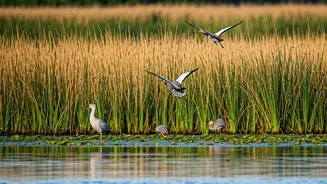
Over time, Chhari-Dhandh has blossomed into a premier destination for bird enthusiasts, researchers, and ornithologists from across the globe. Tour operators and experts in birdwatching trails report that a substantial majority, exceeding 80%, of the reserve's visitors are international tourists, with significant numbers hailing from Nordic countries, the United States, and the United Kingdom. The wetland has welcomed individuals from more than 52 different nations, a testament to its international appeal. Ecologists recognize Chhari-Dhandh as one of Asia's most crucial wetlands for migratory avian populations. Extensive surveys conducted within the broader Banni wetlands have documented over 50,000 waterbirds, including an astonishing congregation of more than 40,000 cranes at a single location. This biodiversity hotspot boasts a documented avian population of approximately 283 species in and around the reserve, encompassing 11 species categorized as globally threatened and nine as Near Threatened.
Sustained Conservation Success
Following its designation as a Conservation Reserve in 2008, the Gujarat government has diligently implemented sustained conservation measures. These efforts encompass crucial aspects such as habitat restoration and protection, rigorous ecological monitoring, and active community engagement. As a result, the reserve now exhibits the highest bird diversity within the Kachchh district, with an impressive count of 187 species, representing over 35% of Gujarat's total avifaunal diversity. The presence of the Grey Hypocolius is particularly noteworthy; in April 2025, an estimated population of 500–600 individuals was observed within the reserve. Spanning approximately 22,700 hectares and encompassing twelve villages, Chhari-Dhandh's strategic location at the nexus of tropical thorn forest, Banni grassland, and the Little Rann landscape facilitates diverse habitats and rich assemblages of both flora and fauna, vital for maintaining ecological equilibrium.
Global Significance Revealed
The Ramsar designation was primarily awarded to Chhari-Dhandh due to its rare desert wetland characteristics, its exceptional biodiversity, and its pivotal role as a critical stopover and wintering ground for migratory birds traversing the Central Asian Flyway. The wetland provides essential feeding and resting grounds for over 180 bird species. Gujarat's geographical position at the southern extremity of the Central Asian Flyway makes its wetlands, including Chhari-Dhandh, indispensable for avian species migrating from Central Asia, Iran, and Siberia. This makes the site of profound global ecological importance, offering vital support to these long-distance travelers during their annual journeys and ensuring the continuity of their migratory patterns.