







The Buffet Dilemma
In the bustling tech hub of Bengaluru, where engineering prowess is applied to almost every aspect of life, even the joyous chaos of a wedding buffet is now
subject to algorithmic optimization. An AI engineer named Pankaj has gained significant online attention for developing "BuffetGPT," a clever, data-driven approach to managing the overwhelming array of choices at large Indian weddings. The inspiration stems from a universally relatable problem: the limited capacity of the human stomach versus the seemingly endless culinary offerings at a wedding, often leading to post-meal regret. Pankaj's system mirrors how AI tackles complex data problems, breaking down the buffet into manageable inputs, establishing clear priorities, and ultimately aiming for an optimal guest experience.
AI's Approach to Eating
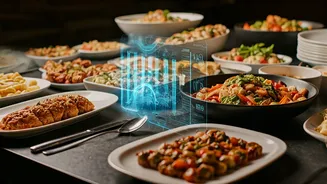
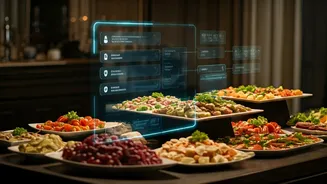
BuffetGPT initiates its strategic planning through meticulous visual scanning of the buffet spread. It doesn't just see food; it classifies each item into distinct categories. High-value dishes, which include rare, special, or wedding-specific delicacies, are identified for prioritization. Conversely, "filler" foods—those commonly found at home or designed purely to induce a sense of satiety—are flagged for less importance. This categorization is crucial for the subsequent allocation phase. For instance, in a scenario involving 13 dishes, the system conceptualizes the stomach as a finite resource with a set budget. Main courses and curries are allocated approximately 50% of this capacity, while breads and side dishes receive a modest 15%. Desserts, often the unique highlight of a wedding feast, are given a generous 35% allocation, underscoring their perceived value.
Strategic Eating Plan
Following categorization and allocation, BuffetGPT formulates an execution strategy, providing a detailed, step-by-step eating plan. Signature dishes like Hyderabadi biryani are designated as a "first target" due to their tendency to run out quickly and the time it takes for them to be replenished. Concurrently, the system advises guests to bypass items such as dal makhani and mixed vegetables. The rationale is that these dishes are readily available elsewhere and are often strategically placed early in the buffet line to expedite the feeling of fullness, thereby limiting a guest's capacity for more premium items. The AI also incorporates physiological considerations; for example, it notes that kadhi pakoda can expand significantly in the stomach, and the water content in raita might create a premature sensation of being full. Interestingly, a surprising recommendation is to consume buttermilk before dessert, as it's believed to aid in creating additional space for sweets.
Dessert Prioritization
When it comes to the sweet finale, BuffetGPT delves into opportunity cost analysis. It suggests favouring richer, denser desserts like rasmalai over kheer, reasoning that kheer is a more commonly prepared sweet that can be enjoyed at home. Ghewar also receives special commendation, with the AI observing that desserts located further away from the main buffet typically have shorter queues. Furthermore, the brief walk to reach these distant sweet stations is posited to aid digestion, making them a more strategic choice. Ultimately, BuffetGPT categorizes all dishes into clear directives: "must try," "small portions," and "skip." Biryani, ghewar, and rasmalai are consistently placed on the "must-try" list, while staples like steamed rice and dal makhani are firmly relegated to the "avoid" category.
Internet's Take
The innovative concept of BuffetGPT has naturally sparked a varied reaction across the internet, eliciting a mix of admiration and playful skepticism. Many users expressed amusement and appreciation, with one commenter humorously noting that Pankaj had solved a problem they didn't even realize existed. The idea even spurred imaginative speculation about future advancements, such as the possibility of drones scanning buffet counters autonomously. However, not all reactions were overwhelmingly positive; some viewed it as an over-engineered solution to a minor inconvenience. Regardless of the varied opinions, Pankaj's BuffetGPT has undeniably demonstrated that in Bengaluru, even the process of enjoying a wedding feast can be approached with the precision and optimization akin to advanced algorithms.