




The Ancient Origins of Cookies
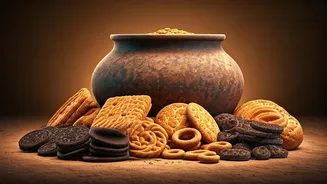
The cookie often perceived as ultra-modern, with its striking black and white design and aggressive branding, actually made its debut in 1912. It's fascinating
to consider that people were enjoying this very cookie while engaging in activities like riding horses to their appointments. Even more surprising is that this iconic cookie was itself a derivative, a copy of an already existing confection. This revelation challenges our perception of novelty, suggesting that the fundamental concept of a sweet, crisp treat has a lineage far deeper than its contemporary appearance might suggest. The essence of the cookie, the combination of flour, sugar, and fat, has been refined over time, but its core idea is remarkably vintage, arriving long before the era of pervasive marketing and vibrant packaging we associate with food today.
Dipped Delights from Antiquity
The practice of dipping various edibles into sugar dates back thousands of years, long before modern confectionery techniques were even conceived. Essentially, what we now recognize as branded, packaged sweets involving a sugar-coated element is simply an evolution of this ancient method. The introduction of specific names and branding in the 20th century was a commercial overlay on a practice that has been enjoyed across cultures for millennia. This means that when you consume such a snack, you are partaking in a tradition that has persisted through countless generations, a direct link to our ancestors' simple, sweet indulgences. The fundamental pleasure derived from combining a base with a sweet coating is a testament to enduring human taste preferences.
The Enduring Appeal of Chocolate
Rich, smooth milk chocolate, often thought of as a product of advanced scientific innovation, actually emerged over 120 years ago. This delightful confection was being savored by people even before the common invention of tea bags, highlighting its considerable historical presence. The basic recipe and production methods for milk chocolate were established well over a century ago, meaning its fundamental composition has remained consistent for a significant period. The primary difference between then and now lies not in the chocolate itself, but in the infrastructure that supports its consumption and preservation. The absence of refrigeration in earlier times meant different storage methods were employed, but the core experience of enjoying this classic confection has remained remarkably similar through the decades.
From Medicine to Marshmallows
Marshmallows boast an astonishing history, with their origins tracing back to ancient Egypt. Initially, they were derived from a plant and utilized for their medicinal properties. At some point in human history, a pivotal shift occurred where the concept of a therapeutic substance was transformed into a delightful, fluffy confection. This transition from a medicinal application to a sweet treat represents a significant cultural and culinary evolution. The transformation likely involved a playful experimentation with texture and taste, leading to the modern marshmallow we know and love. This journey from ancient remedies to a beloved dessert ingredient showcases a fascinating aspect of human ingenuity and our enduring pursuit of palatable pleasures.
Military-Grade Confections
The colorful, uniformly shaped candies with a resilient shell that can withstand rough handling feel distinctly contemporary. However, these treats were actually developed in 1941, with a specific purpose: to serve soldiers. The robust outer coating was ingeniously designed to prevent the chocolate from melting in the hands of those in service. Consequently, what many consider a favorite snack or a symbol of casual indulgence is, in essence, a product of military engineering. This connection reveals a surprising intersection of culinary creation and wartime necessity, demonstrating how practical demands can lead to innovations that later become everyday pleasures.
The '80s Impression
It's easy to associate the introduction of certain snacks with more recent decades, like the 1980s, a time often linked with the rise of vending machines and office culture. However, this particular treat was actually invented in 1935, a period significantly earlier than commonly perceived. Back then, the concept of 'taking a break' likely involved much different activities, such as pausing a horse journey. The fundamental elements—the chocolate, the wafers, and the satisfying way it breaks apart—have remained consistent. This snack's existence predates World War II, underscoring that its core appeal and structure have been a constant for nearly a century.
Spiteful Snack Origins
The creation of potato chips stems from a rather amusing historical anecdote from the 1850s. The origin story involves a customer who expressed dissatisfaction, finding their fries to be too thick. In response to this complaint, a chef, perhaps out of annoyance, sliced the potatoes exceedingly thin, fried them to a crisp, and served them. To the chef's surprise, the customer absolutely loved this new, thinly sliced version. This incident suggests that one of the world's most beloved and widely consumed snacks came into existence purely because of a chef's irritation. While the thinness and crispiness are a result of culinary ingenuity, the very existence of the snack can be attributed to a moment of pique.
The Baseline of Chocolate
This particular type of chocolate is often considered the standard, the benchmark against which other chocolates are measured. It has been available since 1900, which is a substantial amount of time. To grasp its age, consider its original marketing slogan: 'More sustaining than meat.' This tagline offers a vivid glimpse into the perceptions and needs of people in that era, highlighting the perceived nutritional value of chocolate when compared to staple foods. For over 120 years, this chocolate has remained essentially the foundational standard for many people's definition of what 'chocolate' should be, demonstrating its enduring influence and widespread acceptance.