
A Cosmic Revelation
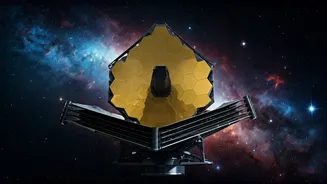
Astronomers have long studied Betelgeuse, the massive red supergiant star. The Hubble Space Telescope's recent observations revealed more about this prominent
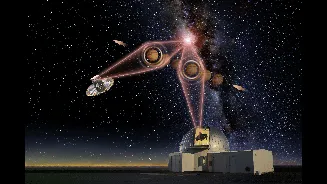
star. Data showed a significant wake that provided insight into its interaction with an unseen companion star. This discovery validates predictions and enhances comprehension of how stars evolve and interact within space. The telescope's advanced technology made this detection possible, unveiling the secrets of Betelgeuse and its stellar neighbor. This new observation offers a view into binary star systems and their complex interactions, which aids scientists in understanding stellar dynamics.
Hubble's Unveiling Powers
The Hubble Space Telescope's ability to capture high-resolution images is crucial to this finding. It allowed scientists to observe minute details that would remain hidden to ground-based telescopes. The wake detected by Hubble indicates the presence of a companion star. This companion, obscured from direct view, influences Betelgeuse's behavior. The ability of the Hubble telescope to identify such subtleties highlights its essential function in modern astronomy. Hubble's precise measurements and imaging tools have provided detailed insights into the dynamics of Betelgeuse, clarifying prior theories about stellar systems and the nature of space. The data helps scientists investigate the forces at play within these systems.
Betelgeuse's Secrets
Betelgeuse, known for its reddish hue, is nearing the end of its life cycle. The companion star found by Hubble provides important context to how Betelgeuse will transition. The interactions between these two stars affect the rate and nature of the red supergiant's transformation. This new research expands upon previous estimations, which suggests the star is set to explode. The companion’s gravitational effects and material exchanges are expected to influence how Betelgeuse changes. The revelation enables scientists to refine models of stellar evolution and to examine the different stages of this significant process. The observation improves current knowledge about the life cycle of large stars.
Future Implications
The Hubble's discovery has significant implications for future research. It pushes forward the ongoing studies on stellar dynamics. The information will inform future missions and technological developments focused on space exploration. Understanding binary star systems is an active area of study. As a result, the findings are essential for investigating cosmic events and the origins of matter in the universe. Scientists can refine simulations and predictions by using the information to refine stellar models. This new understanding opens up more areas of space-related discovery.