




A New View
The James Webb Space Telescope has achieved a monumental feat, generating the first-ever detailed 3D map of Uranus's upper atmosphere. This advanced imaging
capability allows scientists to peer into the dynamics of the ice giant with unprecedented clarity. The telescope's infrared vision pierces through Uranus's atmospheric haze, revealing distinct atmospheric bands and features. This new dimension of observation is crucial for studying phenomena like large-scale storms and the intricate patterns of cloud formations. In particular, the vivid portrayal of methane clouds offers vital clues about the atmospheric composition and the complex circulation systems operating on Uranus. This revolutionary mapping technology is set to transform our comprehension of planetary atmospheres, not just within our solar system but also among exoplanets.
Atmospheric Insights
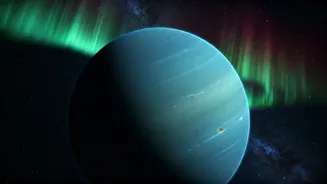
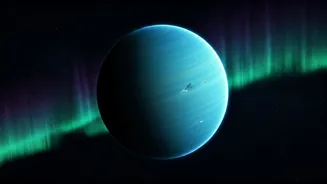
Webb's comprehensive observations have mapped Uranus's atmosphere up to an altitude of 5,000 kilometers, providing a detailed vertical profile. The collected data confirms that Uranus is still gradually cooling, indicating that its atmospheric conditions are subject to long-term changes. During a full day of observation, Webb meticulously measured temperature and ion concentrations at various altitudes. The results pinpointed peak temperatures occurring between 3,000 and 4,000 kilometers above the cloud tops, while ion density reached its maximum near 1,000 kilometers. This precise mapping also illuminated the locations where bright auroras manifest within the ionosphere. Notably, two brilliant auroral bands were observed near the planet's magnetic poles, separated by a dark region, a pattern that also appears on Jupiter.
Unusual Magnetosphere
Uranus possesses a magnetic field that is exceptionally unusual, tilted at a significant 60 degrees from its rotational axis and not centered within the planet. This unique configuration, combined with Uranus's axial tilt that causes its poles to point towards the Sun for extended periods, results in distinct auroral displays. Unlike Earth's polar lights, Uranus's auroras traverse its mid-latitudes. The Webb map vividly illustrates the extent of Uranus's magnetosphere, showcasing how its highly tilted magnetic field extends deep into the planet's atmosphere. This peculiar characteristic makes Uranus's magnetosphere one of the most intriguing and complex found within our solar system, prompting further study and comparison with other planetary systems.