



Black Holes Unleashed
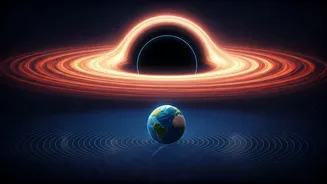
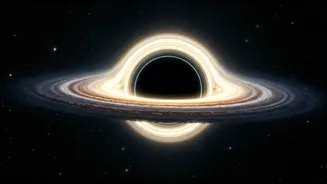
At the heart of many galaxies resides a supermassive black hole, a gravitational titan with a pull so intense that nothing, not even light, can escape.
Astronomers focused their attention on a distant galaxy dubbed Pablo, where they saw a critical event unfold. The James Webb Space Telescope's advanced instruments exposed how this black hole was actively preventing star formation within Pablo. Black holes, despite their invisibility, shape galaxies dramatically. They can gobble up surrounding material, including gas clouds essential for star birth. This process, often referred to as 'starvation,' effectively chokes off the supply of fresh materials required for stars to form.
Pablo's Starry Fate
The observations revealed a clear process. The black hole within Pablo, a relatively young galaxy, was actively ejecting vast amounts of energy and material. This outflow interfered with the galaxy's ability to create new stars, effectively stunting its growth. The process is not instantaneous; it takes time. The Webb telescope provided evidence that the black hole’s influence was gradually reducing the availability of the gas and dust necessary for star formation. Without these raw ingredients, the galaxy was slowly but surely fading in its ability to birth new stars. This discovery sheds light on the life cycles of galaxies. It highlights how black holes regulate star formation, thus influencing the overall character of a galaxy over billions of years. The implications are far-reaching, helping scientists better comprehend galaxy development within the universe.
Webb Telescope's Role
The James Webb Space Telescope is pivotal to these discoveries. Its sensitive infrared capabilities let it peer through cosmic dust and observe the internal workings of Pablo. It provides astronomers with detailed data about the energy levels and distribution of elements within the galaxy. This data has aided scientists in assessing the black hole’s impact on Pablo. The data shows how the black hole impacts the gas that feeds star formation. The telescope enables scientists to measure the speed and direction of outflows from the black hole. The depth of the data provided by the Webb telescope offers unprecedented insights into the processes within the cosmos. The research serves as an example of how advanced technologies are driving scientific advances in astrophysics.
Galaxy Evolution Unveiled
This research provides deeper insights into galaxy evolution. Scientists have come to understand that galaxies' life cycles are largely dependent on the presence and activities of supermassive black holes. The black hole's influence can prevent the formation of stars, potentially causing a galaxy to age prematurely. In contrast, in galaxies where black holes are less active or absent, stars may continue to form for much longer periods. Understanding these processes is a major step in piecing together the formation and evolution of the universe. The study provides additional information for future research. Scientists are eager to extend these types of observations to a wider variety of galaxies. This will allow them to further refine their models of galaxy evolution.