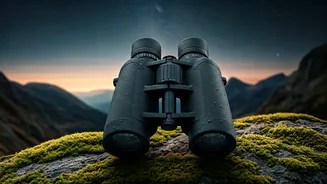

Magnification & Light Mastery
The standout feature of these binoculars is their substantial 15x magnification, providing an impressive ability to bring distant subjects into sharp focus.
This level of zoom is particularly advantageous for observing elusive songbirds in dense foliage, waders on distant shorelines, or the majestic flight of birds of prey high in the sky. While an 18x option exists, the 15x power generally offers sufficient reach for most users without compromising usability. Complementing the magnification are the large 50mm objective lenses, which excel at gathering ample light. This capability significantly extends viewing opportunities into twilight hours, allowing for an extra 20 to 30 minutes of observation during longer summer days. Consequently, spotting crepuscular creatures such as owls, badgers, and deer becomes a much more achievable endeavor, showcasing the binoculars' efficacy in challenging light conditions.
Optical Brilliance Unleashed
Image quality is a defining characteristic of these binoculars, largely due to the integration of multi-coated, Ultra-low Dispersion (UD) glass. This advanced optical system minimizes chromatic aberration, ensuring that color fringing, such as the subtle purple hues sometimes seen at the edges of the image circle, is kept to a bare minimum. Furthermore, the inclusion of a doublet field flattener effectively combats distortion, resulting in consistently pleasing, bright, and sharp views across the entire field of vision, irrespective of whether you are observing during daylight or under the night sky. This meticulous attention to optical design ensures a visually comfortable and highly detailed observation experience.
Functionality & Ergonomics
The functionality of these binoculars is enhanced by their image stabilization system, which proves invaluable for both wildlife observation and stargazing by holding the view steady. However, a minor drawback is the absence of a diopter locking mechanism, meaning the diopter adjustment, while sufficiently stiff, could potentially be nudged unintentionally. A more significant practical concern is the battery compartment, which has been noted as being somewhat tricky to open, sometimes requiring significant effort or tools like a coin or flathead screwdriver. This can be a point of frustration, particularly for individuals with limited dexterity. Despite these functional quirks, the overall performance and optical quality largely overshadow these minor inconveniences, making them a compelling choice.
Design Considerations & Build
While these binoculars offer substantial weight due to their advanced optics and stabilization technology, this heft is generally considered a worthwhile trade-off for the superior quality they deliver. The green, rubberized coating is a thoughtful design choice for wildlife enthusiasts, helping them to blend into natural surroundings, a departure from conventional black finishes. However, a notable downside is that this rubberized coating tends to be slippery and marks or dents quite easily, which can be a concern for durability during rugged outdoor use. The eyecup design offers only two positions (flap-up or flap-down), which might be less adaptable than the multi-position twisting eyecups found on other models, especially for eyeglass wearers seeking optimal eye relief. On a positive note, the interpupillary distance adjustment, integrated into the eyepieces, ensures a stable grip and prevents hinge looseness over time. The strap attachment points, cleverly built into the rotating eyepiece sections, contribute to a more balanced and comfortable carry.
Performance in Practice
In practical use, the 15x magnification consistently proves its worth for bird spotting from a distance, allowing for detailed examination of feathered subjects without disturbing them. The image stabilization system activates with ease, transforming shaky views into steady, clear observations, which is crucial at this magnification level and for astronomy. Despite the 'all-weather' labeling, it's important to note these binoculars are water-resistant rather than fully waterproof, a distinction that might cause confusion given the marketing. The performance of the optics, including the UD glass and multi-coating, delivers sharp, bright images across the entire field, mitigating issues like vignetting or edge softening. While the diopter ring is suitably firm, its lack of a locking feature is a minor point of contention for some users, although it generally holds its setting well during typical use.