
Bridging Physics and Biology
The application of string theory, a sophisticated theoretical framework born from physics, is being ingeniously adapted to dissect the complexities of biological
networks. This unconventional approach seeks to draw parallels between the fundamental building blocks in physics and the intricate interactions within living systems. By viewing biological networks through the lens of string theory, researchers can construct mathematical models capable of capturing the dynamic behavior of these complex systems. This method helps to identify and analyze the fundamental principles that govern how these networks function. It helps understand how different proteins interact, the cascade of biochemical reactions, and the pathways that control cellular activity. This exploration allows for a deeper understanding of life's essential processes, providing a new dimension to biological research.
Modeling Biological Networks
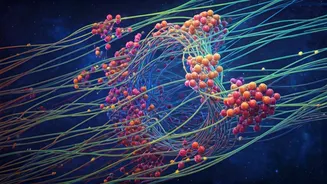
String theory's mathematical models are powerful tools for visualizing and interpreting biological network behavior. Scientists leverage the theory to represent complex interactions as interconnected networks, akin to the strings within the theory. The string theory framework lets researchers simulate and analyze how these networks change in response to different conditions, such as environmental stimuli or genetic mutations. For instance, the intricate interplay of proteins within a cell or the cascading effects of a metabolic pathway can be modeled, leading to predictions about their behavior. These models go beyond simple cause-and-effect relationships and reveal the underlying network dynamics. String theory enables scientists to decode the patterns and mechanisms that drive cellular processes, which is impossible using traditional methods. This provides significant potential for advancing our understanding of disease mechanisms and the development of new therapeutic interventions.
Insights into Protein Interactions
The implementation of string theory provides a fresh vantage point for investigating protein interactions, which are crucial for numerous biological functions. Protein interactions are essential for understanding how cells work, what they do, and how they respond to different conditions. By applying the concepts from string theory, scientists can build detailed models that simulate how proteins bind to each other, creating intricate complexes and pathways. These models are not just static representations; they help to illuminate how the strength and timing of interactions change, revealing vital information. This helps to pinpoint the key proteins that are essential in cellular processes. Identifying critical proteins helps scientists to design more effective strategies for treating various diseases.
Predicting Biological Processes
One of the most promising applications of string theory in biology is its ability to forecast biological processes, and the resulting capabilities are immense. The models derived from this approach go beyond simply describing what is happening and predict what will happen next. Scientists can forecast how a biological network will respond to interventions like a new drug or environmental changes by using string-theory-based models. This predictive power allows for the optimization of treatment strategies and the identification of potential side effects before clinical trials. This is crucial for developing personalized medicine. It allows doctors to tailor treatments to each patient's unique genetic profile and the specific characteristics of their disease. These capabilities are crucial to driving the future of healthcare.
Future of String Theory
The integration of string theory into biology is still in its early stages, but the results so far point to a revolutionary change in scientific research. The potential for the study of the complex behavior of biological systems is significant. Future research could focus on making these models more accurate, integrating them with more advanced data sets, and expanding their use into new areas of biology. This is the first step in creating a fully detailed model of the intricate dynamics of biological systems. With time, these models will enhance our knowledge of health, disease, and how to improve the quality of human life. Through innovation and experimentation, string theory can change the field of biology, leading to deeper insights and ground-breaking discoveries.