






Nature's Engineers at Work
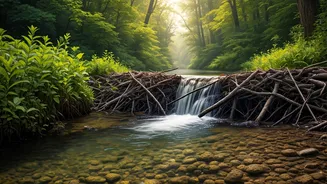
Beavers are renowned for their engineering prowess, constructing dams that create vital ponds and lodges. These structures significantly influence water
flow and are crucial for maintaining healthy stream ecosystems. Volunteers, like the Beaver Brigade in Bernheim Forest, actively support these natural engineers. Their work involves monitoring beaver populations, planting food sources, and even scouting for new dam sites or lodges. In a remarkable initiative, these volunteers construct 'beaver dam analogs' (BDAs) – structures designed to mimic beaver dams. These BDAs are built by pounding wooden posts into stream beds and weaving willows and grasses between them. This method aims to initiate new dams that beavers will then complete, or to replace dams lost to natural forces. The goal is to encourage beaver activity in specific areas, such as parts of the forest far from human disturbances like roads and arboretums. The positive impacts of BDAs extend beyond the beavers themselves, as studies worldwide highlight their role in fostering vegetation growth, improving stream habitats, and even enhancing water quality, showcasing a clever way to restore damaged river ecosystems by learning from nature's original architects.
Historical Context and Rediscovery
Centuries ago, North America was teeming with beavers, numbering in the hundreds of millions. However, the burgeoning fur trade, driven by European settlers from the early 1600s seeking soft pelts for clothing and hats, led to a drastic decline in their population. By 1900, estimates suggest their numbers had plummeted to a mere 100,000. This severe reduction in beaver activity resulted in the shrinking and disappearance of many wetland ecosystems. Rivers that once meandered and spread across wide floodplains became channelized, carving narrow paths through the land. This alteration created opportunities for human agriculture and settlement in the newly exposed flat areas. It wasn't until the early 2000s that scientists began to re-evaluate the concept of a healthy river system. Ecologists discovered that pre-settlement rivers were characterized by meandering courses and extensive floodplains, often described as 'messy and muddy.' This shift in perspective led researchers, including fish biologist Michael Pollock, to reconsider the role of beavers and their dams in maintaining these dynamic riverine landscapes.
Restoring Steelhead Habitat
Michael Pollock, working with NOAA Fisheries, became concerned about the declining numbers of steelhead trout smolts, young fish that migrate from freshwater streams to the ocean. He observed that these smolts thrived in streams with beaver dams, which created wide, cool pools that provided essential refuge and foraging opportunities. Pollock hypothesized in a 2004 paper that beaver dams slowed water flow, leading to the formation of these beneficial pools. He recognized that a lack of beaver dams meant a significant reduction in critical habitat for young fish. This led to the groundbreaking idea: could building BDAs help restore populations of steelhead trout? The opportunity to test this arose at Bridge Creek in central Oregon, a place where beavers had historically flourished but had largely disappeared due to fur trapping. The remaining beavers struggled to maintain their dams against the creek's fast-flowing waters, which would often destroy their efforts, a condition known as an 'incised stream'—a narrow channel with steep sides carved by rapid water flow, often a result of human activities like removing natural obstructions. The goal became to create a structure that could stabilize the stream and entice beavers back.
The BDA Intervention
In 2008, Pollock and a team embarked on a mission at Bridge Creek, targeting a site where a beaver dam had previously been destroyed. They waded into the fast, cold water to install sturdy wooden posts, driving them deep into the streambed to withstand the strong current. These posts were arranged across the stream, approximately one foot apart, and then woven together with willow branches. This carefully constructed barrier, a beaver dam analog (BDA), was designed to slow the water's flow while still allowing some passage. Willows were chosen specifically because they are a natural part of the ecosystem, are edible for beavers, and if the BDA were to fail, the willow pieces could potentially re-root downstream. The team selected a location where they knew beavers had previously built, hoping their presence would encourage the rodents to return and complete the structure. Their efforts were met with rapid success. The following year, when Pollock revisited the site, the initial BDA framework had been transformed into a robust beaver dam, with the beavers adding wood and mud to reinforce it. This intervention not only re-established the beaver dam but also initiated a cascade of positive ecological changes, including the creation of larger pools, increased sediment deposition that raised the water level and widened the stream, accelerated vegetation growth, reduced bank erosion, and provided ideal shallow habitats for steelhead trout.
Ecological Ripple Effects
The success at Bridge Creek spurred Pollock's team to build more BDAs along the waterway. This approach offered a stark contrast to earlier stream restoration methods, which often involved heavy machinery like bulldozers to excavate floodplains and lower stream levels. BDAs, in contrast, are a low-cost, low-tech solution that works with natural processes. By slowing water and encouraging sediment accumulation, BDAs effectively re-establish natural flooding on original floodplains. While beaver dams are not permanent and will eventually break down, this is part of the natural cycle, allowing beavers to move on and younger generations to build anew. Since the initial BDA construction, these structures have been implemented globally, from the American West to Switzerland and France, with researchers continually refining designs for various purposes like floodplain widening or beaver reintroduction. These BDAs are considered a remarkable and cost-effective tool for ecosystem restoration. Furthermore, recent research by Woutrina Smith's team at the University of California, Davis, has shown that BDAs can significantly improve water quality by filtering out harmful germs and parasites. Experiments demonstrated that BDAs effectively trap these contaminants, which often adhere to larger particles that settle at the stream floor. The slowed water flow also allows microbial predators more time to eliminate harmful bacteria. This makes BDAs a valuable, low-cost method for enhancing the health of both wildlife and human communities by improving water safety.
Carbon Storage and Global Impact
Beyond their direct impact on stream health and water quality, beaver dams are now recognized for their significant role in carbon sequestration. Studies, such as one conducted by Lukas Hallberg's team at the University of Birmingham in England, have revealed that European beavers returning to streams and creating ponds and wetlands are effectively trapping carbon, which can help mitigate global warming. By slowing water flow, beavers create ponds and wetlands that cause suspended soil particles and decaying plant matter, both rich in carbon, to settle. This carbon-rich sediment forms a muck layer at the bottom of the pond. The water covering this muck acts as a barrier, limiting oxygen's access and thus preventing microbes from breaking down the organic material and releasing carbon dioxide and methane into the atmosphere. Research in a Swiss stream indicated that the carbon stored in this muck beneath beaver ponds could be up to 14 times greater than in surrounding forest soils. This discovery highlights beavers as a rare example of wildlife actively engineering new carbon storage systems. BDAs can therefore be seen not just as tools for habitat restoration but also as crucial components in the fight against climate change, amplifying the natural carbon-capturing capabilities of wetlands.