







Contactless Friction Unveiled
A groundbreaking discovery at the University of Konstanz has unveiled a completely novel mechanism of sliding friction that operates entirely without any
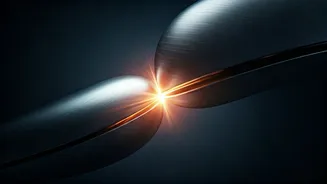
direct physical contact between surfaces. Instead of the usual grinding and rubbing, the resistance to movement in this phenomenon stems from the collective behavior of magnetic forces. The implications are profound, as these findings suggest that friction does not invariably climb with an increased load, a notion that contradicts Amontons' law, a foundational principle in physics for over three centuries. Amontons' law typically dictates that the heavier an object, the greater the friction encountered when trying to move it. This new research indicates that magnetic forces can introduce a peak in friction when the internal magnetic alignment within the system becomes disordered or 'frustrated,' leading to a departure from the predictable linear relationship previously understood.
Challenging Amontons' Legacy
For more than 300 years, the scientific community has relied on Amontons' law to quantify friction, a law elegantly capturing the intuitive understanding that greater weight necessitates more force to initiate movement. This principle is readily observable in everyday scenarios, such as the strenuous effort required to push a heavy piece of furniture compared to a lighter object. The conventional explanation for this phenomenon involves microscopic surface irregularities that interlock under pressure, thereby increasing the points of contact and consequently the friction. While this holds true for most common materials and situations where internal structures remain largely unaffected, the question of its applicability to materials with dynamic internal arrangements, like magnets, remained open. Sliding in magnetic materials can fundamentally alter their magnetic order, prompting an investigation into whether Amontons' law still governs such complex scenarios.
Magnetic Play: Experimental Design
To explore the intriguing relationship between magnetic materials and friction, scientists devised an ingenious tabletop experiment. This setup involved two distinct layers of magnets: an upper layer composed of freely rotating magnetic elements and a lower magnetic layer. Crucially, these layers were positioned so they never made physical contact, yet their magnetic interplay generated a measurable force of friction. By meticulously controlling the separation distance between these two magnetic layers, the researchers were able to manipulate the effective 'load' on the system. Simultaneously, they observed how the intricate magnetic structures within the layers reconfigured themselves as they moved relative to each other, providing unprecedented insight into the dynamics at play during this contactless friction.
Magnetic Alignment and Motion
The experiment revealed a fascinating pattern in the friction levels relative to the distance between the magnetic layers. Friction was found to be minimal when the layers were either very close together or quite far apart. However, at intermediate distances, a unique situation emerged where competing magnetic forces became dominant. The upper layer of magnets tended to align themselves in an antiparallel fashion with the lower layer, meaning their magnetic poles would point in opposite directions. Conversely, the lower layer preferred a parallel alignment. This conflicting preference created an inherently unstable magnetic state. As the layers slid past one another, the magnets were compelled to repeatedly switch between these opposing configurations in a cyclical, history-dependent manner known as hysteresis. This continuous reorientation process led to significant energy dissipation, resulting in a pronounced peak in the observed friction force.
Friction from Magnetism, Not Contact
From a theoretical standpoint, this system presents a remarkable departure from conventional friction principles. The resistance to motion here is not born from the physical interaction of surfaces but from the intricate, collective dynamics of magnetic moments. The inherent competition between magnetic interactions naturally induces a hysteretic response, meaning the system's state depends on its past movements, as magnets reorient themselves during sliding. This leads to a friction force that does not increase smoothly with load but fluctuates, exhibiting a non-monotonic behavior. Therefore, the observed breakdown of Amontons' law is not an aberration but a direct consequence of how magnetization itself evolves during the sliding process, offering a profound new perspective on the nature of friction.
Wear-Free Friction Potential
The most astonishing aspect of this discovery is that friction arises solely from the internal reorganization of magnetic elements, entirely circumventing the need for physical contact, surface roughness, or any form of wear. The energy dissipation occurs purely through the collective magnetic rearrangements within the system. Importantly, the underlying physics governing this contactless friction is not confined to the specific scale of the experiment. Similar phenomena are anticipated to manifest in ultrathin magnetic materials, where even minute movements can significantly alter the magnetic order. This opens up exciting new avenues for both studying and precisely controlling magnetic properties by observing and measuring frictional forces, bridging the fields of tribology and magnetism in an unprecedented way.
Future Technological Horizons
Looking ahead, this research holds the promise of developing friction systems that can be precisely tuned without generating any wear. By harnessing magnetic hysteresis, it may become possible to adjust friction remotely and reversibly. This capability could pave the way for innovative applications such as friction-based metamaterials, adaptive damping systems that respond dynamically to external forces, and sophisticated contactless control devices. Potential applications are vast, spanning micro and nanoelectromechanical systems (MEMS/NEMS), where wear is a significant limitation, as well as advanced magnetic bearings, vibration control technologies, and the development of next-generation ultrathin magnetic materials. Ultimately, magnetic friction provides a novel mechanical pathway to investigate collective spin behavior, fostering a unique synergy between different scientific disciplines.