



A Metal World Mystery
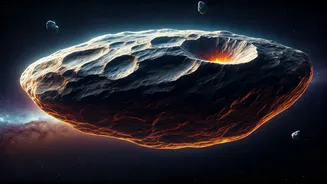
For over two centuries, asteroid 16 Psyche has baffled scientists, its formation a persistent enigma. This colossal object, the 10th most massive in the asteroid belt
and the largest known metallic asteroid at approximately 140 miles in diameter, is the target of NASA's ambitious Psyche mission, slated for arrival in 2029. Current scientific hypotheses propose two main origins: either Psyche is the shattered core of a protoplanet that lost its rocky mantle due to immense collisions, or it began as a metal-rich body that later became a composite of rock and metal through successive asteroid impacts. Each of these possibilities offers a distinct perspective on the fundamental processes that shaped the early Solar System and the terrestrial planets we see today, making Psyche a crucial Rosetta Stone for planetary science.
Crater Clues Unveiled
Scientists at the University of Arizona’s Lunar and Planetary Laboratory have employed sophisticated simulations to probe the origins of a significant crater near Psyche's north pole. Their research, published in JGR Planets, presents testable predictions crucial for interpreting the data NASA's Psyche mission will collect. By modeling how this large impact basin may have formed under various internal structural conditions, these simulations act as a vital guide. The size of impact craters offers direct insights into the subsurface composition. As Namya Baijal, the lead author and a doctoral candidate, explained, these deep excavations provide clues about what lies beneath the surface. This innovative approach aims to resolve the ambiguity surrounding Psyche's composition, determining if it's primarily metallic, mixed, or layered, once the spacecraft begins its observations.
The Role of Porosity
A key revelation from the crater simulations is the significant influence of porosity – the presence of empty spaces within the asteroid – on impact dynamics and resulting crater morphology. Often overlooked due to the complexity of incorporating it into models, porosity, according to Baijal, can profoundly affect how an impact event unfolds. Asteroids with higher porosity are more compressible, allowing them to absorb impact energy more effectively. This leads to the formation of deeper, steeper craters with less material ejected onto the surrounding surface. The study's findings underscore the importance of considering this factor; by comparing simulated crater features influenced by porosity with actual observations from the Psyche mission, scientists can more accurately distinguish between a layered internal structure and a more homogenous, mixed composition of metal and rock.
Psyche and Planetary Genesis
The scientific investigation into Psyche draws a compelling parallel to deciphering an ancient pizza shop to understand how pizzas were made, even after the cooks have departed. Like these leftover pizza ingredients, main belt asteroids are believed to be remnants from the tumultuous era of planet formation. Professor Erik Asphaug likens this process to examining ovens and dough scraps to infer baking techniques. While direct access to the cores of planets like Earth or Mars remains unattainable, Psyche offers a potential pathway to studying the core of an early celestial body. If Psyche is indeed an exposed planetary core, violently stripped of its outer layers, it would present an unparalleled opportunity to witness a formative stage of planetary development that is otherwise inaccessible to direct observation, providing invaluable context for how terrestrial planets, including our own, came into being.
Simulating a Cosmic Collision
To investigate Psyche's internal makeup, researchers meticulously recreated the formation of a substantial crater, roughly 30 miles in diameter and three miles deep, using detailed 3D models derived from telescope data. The simulations incorporated impact speeds typical of the asteroid belt, around three miles per second, and explored various impactor sizes. Crucially, these models tested two distinct internal structures: a layered body with a metallic core and a rocky mantle, suggestive of a massive impact stripping away outer layers, and a uniform mix of metal and silicate, indicative of a more chaotic, all-encompassing collision. The simulations revealed that an impactor approximately three miles across could generate a crater matching the observed dimensions. Interestingly, the crater's characteristics proved consistent with both proposed internal scenarios, highlighting the need for direct spacecraft data to definitively ascertain Psyche's composition and internal arrangement.
Mission Objectives Ahead
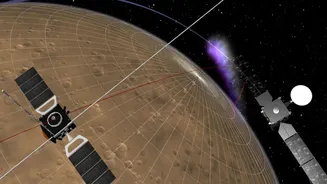
The forthcoming NASA Psyche mission is equipped with a suite of advanced instruments designed to comprehensively analyze the asteroid's surface characteristics, gravitational field, magnetic signature, and elemental composition. Beyond crater morphology, the predictive models generated through simulations highlight other observable features that mission scientists will scrutinize. These include potential density variations resulting from impact-induced compression of the asteroid's interior and the spatial distribution of metallic debris scattered across its surface. As Professor Asphaug notes, the collaborative efforts of geochemists, geologists, and modelers will be focused on interpreting the same object upon the spacecraft's arrival. This preparatory modeling work provides a significant head start, equipping the mission team with a framework to more effectively understand and interpret the wealth of data that Psyche is expected to transmit back to Earth.