





GTC's Strategic Importance
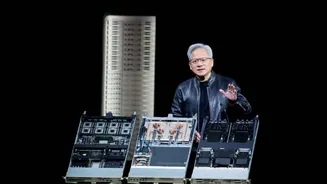
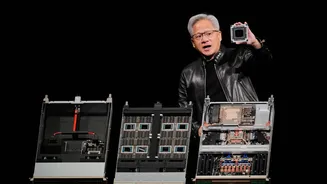
Nvidia's annual developer conference, known as GTC, serves as a crucial platform for CEO Jensen Huang to showcase the company's pioneering advancements
in artificial intelligence. This event has become the primary stage for unveiling new developments across a spectrum of AI technologies, including their high-performance chips, robust data center solutions, the foundational CUDA programming software, intuitive digital assistants dubbed AI agents, and even the physical manifestation of AI in robotics. The upcoming conference holds particular significance as it occurs during a period of intense investor scrutiny, with stakeholders eager to see evidence that Nvidia's substantial reinvestment into the AI ecosystem is yielding tangible results and solidifying its market dominance. Analysts anticipate a comprehensive overview of Nvidia's technology roadmap, highlighting advancements in chip generations, a focus on AI inference capabilities, the growing sophistication of agentic AI, enhanced networking solutions, and the infrastructure underpinning what's termed an 'AI factory.'
Navigating Competitive Pressures
While Nvidia's chips are central to the massive investments poured into data centers globally, the company faces an escalating challenge from rivals and even its own major clients who are developing proprietary hardware. The AI chip market is in constant flux, driven by the emergence of AI agents, which are designed to autonomously perform tasks across various computer applications on behalf of human users. This contrasts with the earlier focus on AI training, where large clusters of Nvidia chips were utilized to process vast datasets for model refinement. The proliferation of these AI agents suggests a future where humans may require a new layer of 'orchestration' AI to manage these agent fleets effectively. While this evolution signals increasing AI utility, a benefit for Nvidia, the tasks associated with AI inference can be executed on a wider range of hardware. This opens the door for formidable competitors and customers, such as OpenAI and Meta, which have announced plans for rapid AI chip development, to reduce their reliance on Nvidia's offerings.
Strategic Acquisitions and Future Products
Nvidia's commitment to maintaining its competitive edge is evident in its strategic investments and product development. The acquisition of Groq, a chip startup specializing in rapid and cost-efficient AI inference, for $17 billion underscores this strategy. Nvidia plans to demonstrate at GTC how Groq's advanced AI technology can be seamlessly integrated into its existing CUDA platform, enhancing inference capabilities. Furthermore, there are expectations that Nvidia will introduce a new line of servers combining Groq's chips with Nvidia's networking technologies, promising a synergistic solution for speed and cost-effectiveness. Beyond GPUs, the company is also re-emphasizing the role of Central Processing Units (CPUs), traditionally associated with Intel and AMD. Nvidia is expected to showcase servers that exclusively utilize its own CPUs, aligning with the growing importance of CPUs in managing the orchestration layer for agentic AI, a point highlighted by CEO Jensen Huang. Additionally, Nvidia's significant investments in Lumentum and Coherent, companies that produce lasers for inter-chip optical communication, suggest a focus on co-packaged optics. This technology aims to accelerate data transfer within massive AI clusters, although scaling its production to meet Nvidia's chip output remains a significant challenge. Nvidia intends to present co-packaged optics as a critical component for efficient AI cluster connectivity, with affordability being a key consideration for widespread adoption.